Heath Haussamen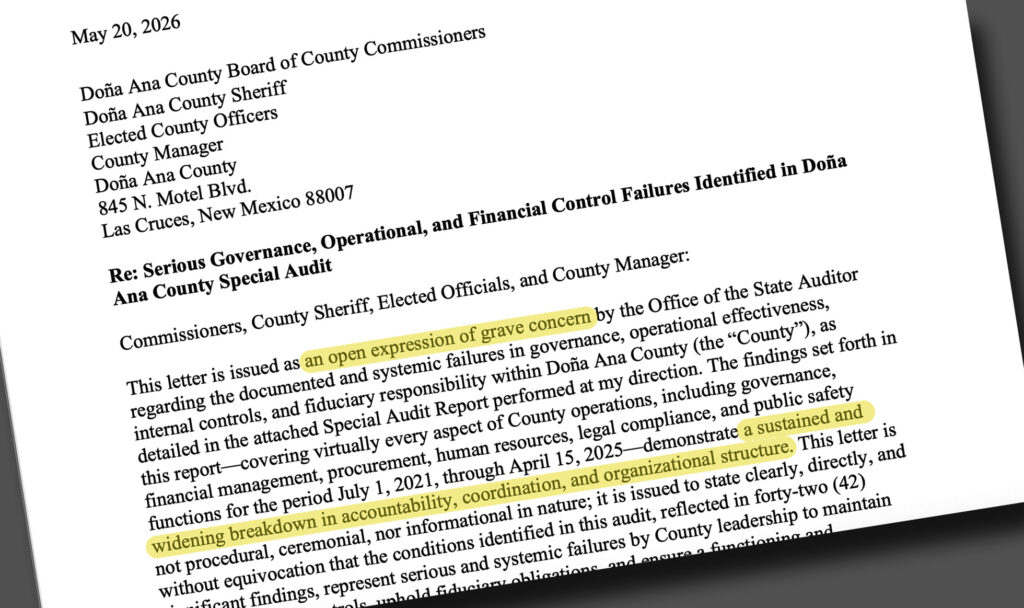
THE DOCUMENTS: Read the special audit and the state auditor’s letter to Doña Ana County
A special state audit reveals deep-seated problems in Doña Ana County government. I hope the elected officials and staff who run the county take its findings seriously and heed the state auditor’s warning.
The audit uncovered “documented and systemic failures in governance, operational effectiveness, internal controls, and fiduciary responsibility,” state Auditor Joseph Maestas wrote in a May 20 letter to the county expressing “grave concern.” The findings “demonstrate a sustained and widening breakdown in accountability, coordination, and organizational structure,” he wrote.
Why does it matter for the county’s residents? The issues identified in the audit indicate a failure by county officials to “ensure a functioning and accountable system of government for the public they serve,” Maestas wrote.
Government best serves people when it operates effectively, efficiently and with integrity. Anyone who paid attention to the county’s handling of the approval of tax incentives for the developers of Project Jupiter knows the county has struggled to do that.
Excluding public from Project Jupiter agreements
In recent months I’ve documented violations of state transparency laws that excluded the public from the process of approving agreements with the developers of the campus of data centers being built in Santa Teresa. I’ve also discovered two problematic mindsets among folks in county government:
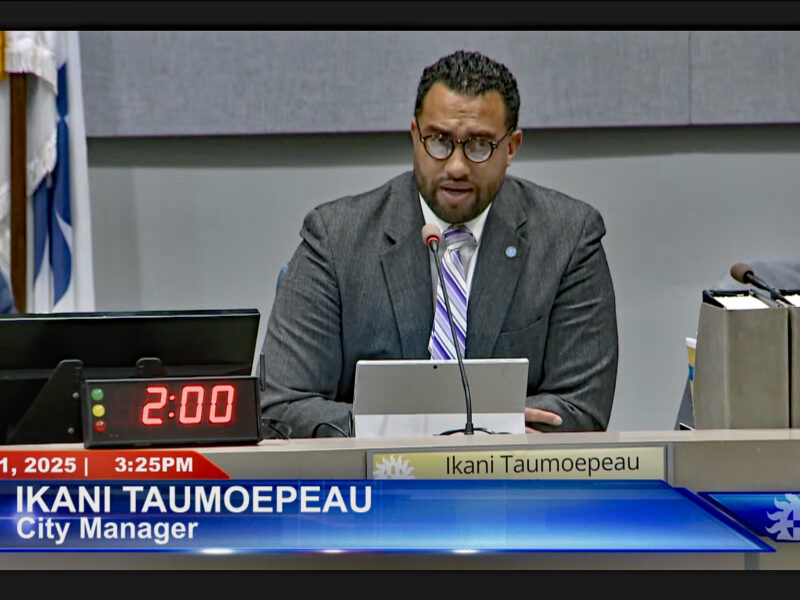
• County Manager Scott Andrews believed it was appropriate to sign a non-disclosure agreement requiring him and county staff to keep secrets from their bosses — the elected officials who represent all of us, the county commissioners — while staff negotiated agreements with the developers alongside state officials.
• Four of five county commissioners believed it was appropriate to approve agreements with the developers that they and the public hadn’t had a chance to read. They also voted to give their chairman authority to negotiate final details of agreements with the developers in secret. That led to agreements growing exponentially behind closed doors, and a substantial shift in Project Jupiter’s allowed water use.
In short, the county executed agreements with massive, out-of-state corporations that substantially impacted the county’s residents without the involvement of those residents.
‘The County must act immediately’
The agreements with Project Jupiter weren’t the target of the audit. A public spat between county administrative staff and the elected sheriff sparked the review, but it expanded to examine “virtually every aspect of County operations, including governance, financial management, procurement, human resources, legal compliance, and public safety functions” from July 1, 2021 to April 15, 2025, Maestas’ letter states.
The audit found a deteriorating organizational culture. “Employees report fear of retaliation, perceptions of favoritism, lack of fairness, and diminished trust in leadership and internal processes,” Maestas wrote. “These conditions directly undermine the County’s ability to deliver services effectively and equitably, and they reinforce the cycle of complaints, disputes, and litigation.”
Maestas called on county commissioners, staff and independent elected officials including the sheriff to implement the audit’s recommendations for reform. Otherwise, he wrote, state intervention becomes more likely.
“The urgency of corrective action cannot be overstated,” he wrote. “The County must act immediately.”
“The people of Doña Ana County are entitled to a government that operates with integrity and competence, and the employees who serve them are entitled to a workplace grounded in fairness and accountability,” Maestas wrote.
Déjà vu
That’s a lot. And it’s not without precedent. For me, Maestas’ letter brings a profound sense of déjà vu — and frustration.
It takes me back to 2004, when I investigated county government as a reporter at the Las Cruces Sun-News and exposed a mountain of problems. The state auditor conducted a special audit back then, too.
Most of that audit’s findings confirmed what we’d already reported: violations of the procurement code, transparency laws and county ordinances. There were missing documents, conflicting public statements and evidence of shady dealing.
Thanks to our reporting, the county was already on the road to corrective action by the time the state auditor got involved. “We’ve worked hard to make sweeping changes in Doña Ana County for the better,” then-County Manager Brian Haines (rest in peace), told me in 2006.
The state auditor at the time, Domingo Martinez, agreed. “It looks like they have made the appropriate changes,” he told me.
Today’s county government sent a news release last week that sounds a lot like Haines’ words from 20 years ago. “Over the past several months, County leadership and departments have been actively reviewing processes, improving coordination and communication, and identifying ways to better support employees and serve the public,” it states.
The news release acknowledged that the audit “does identify areas that require continued attention.”
Deeper cracks remain
I can verify that the county has worked to address some issues in recent months. It’s hired new staff to improve response time to public records requests, for example.
But there are signs that deeper cracks remain within the organization. At a county commission meeting a couple of weeks ago, Chairman Manuel Sanchez and Assessor Eugenia “Gina” Montoya Ortega had a heated exchange in front of the public — without resolving their disagreement.
And last week, County Attorney Cari Neill submitted her resignation, effective June 12. In an email to Andrews, which I obtained through a public records request, Neill complained that the county manager had “hardly spoken” to her for months in spite of promises to meet.
“The lack of communication began last fall, but has intensified over the last several months,” Neill wrote. “Between the issues with (redacted), your lack of communication, and the email that you sent me Friday a week ago which proved that you have no idea what is going on in the legal department, the only reason for me to stay is to ensure my team is protected. And now you have threatened to put most of them under another supervisor who has no legal experience.”
The breakdown in communication between two critical county employees is shocking, given all the county has dealt with in recent months, including the Project Jupiter agreements, the special audit, and Andrews’ controversial efforts to reform the flood commission.
Not all agree
I think it’s important to recognize that not all agree with my analysis of the severity of the situation — or with the state auditor’s warning.
In an interview, Sanchez took issue with Maestas’ letter. “For him to say we were broken, I just felt like it was political grandstanding,” Sanchez said.
He acknowledged there are problems, but said most the audit identified are “related to our old culture, to our previous county manager and processes we had, and things we have been working to fix.”
“I’m glad it happened,” Sanchez said of the audit. “It highlighted the issues I think we all knew we had and have been trying to improve.”
What’s at stake
It’s one thing to try to improve. It’s another to succeed. The continued infighting between commissioners and independent elected officials, and the concerns raised by the county attorney’s email, suggest to me that there’s still work to do. I assume the state auditor will similarly interpret Neill’s email as evidence of problems continuing past the tenure of the previous county manger.
It’s important we — not just the elected officials who lead our county government, or the staff who work there, but also those of us who live here — work to fix these issues.
Because there’s so much at stake:
• The state’s largest economic effort to reduce its dependence on the oil and gas industry is the industrial growth in Santa Teresa, an unincorporated area in the county. It’s where Project Jupiter is being built. There’s immense opportunity for growth there, but some companies will hesitate to commit if they don’t see local government as a stable partner. I can’t imagine Project Jupiter’s developers are happy with this situation.
• The unincorporated community of Chaparral, which is split between Doña Ana and Otero counties, is bursting at the seams and desperately needs the help of both counties to determine a better system of local governance. State Rep. Sarah Silva (who is my spouse), the only local elected official who represents the entire community, has been considering options that include moving the county line or creating an entirely new county, in addition to the incorporation of a city. Doña Ana County needs to be able to step up to help.
• Infrastructure needs throughout the county are pretty serious. They include flood control, roads, parks and community centers. But to continue to have the support of state lawmakers who provide funding for such projects, the county needs to be a trusted partner.
• The county and the City of Sunland Park are in the process of separating a shared water and sewer system and battling over how much land the city can annex. The county needs to be up to the task of helping solve these challenges.
• Because of concerns that Memorial Medical Center may not be providing the care its legal agreements require, the county has joined the City of Las Cruces in alleging a breach of contract and suing the hospital’s owner.
Time for reflection, collaboration and courage
The health, safety and welfare of the county’s 230,000 residents is at stake. It’s no exaggeration to say the future of New Mexico’s economy is also on the line. We’ve spent decades and billions building out Santa Teresa.
I was there, 20 years ago, and can honestly say county officials put their best effort into reform. Clearly, those changes didn’t last. Today’s county officials need to recognize that. Commissioners plan to vote next week to establish processes for “addressing and correcting audit findings,” but implementing the state auditor’s recommendations won’t be enough.
The infighting and grandstanding needs to stop. Elected officials and staff need to be reflective, collaborative and courageous. I hope residents are as vocal about this situation during public input at commission meetings as they have been about Project Jupiter.
I believe the county needs to undergo an intensive, systemic review of its organizational culture. Based on Neill’s email, I also think commissioners should evaluate the county manager’s performance.
I don’t want to write yet another version of this column down the road. The county’s problems have dragged on for far too long. We deserve better.
AN ASK: Friends, I really need to increase the number of folks supporting my journalism with monthly donations. Or, if you can’t do that, I could really use a one-time gift. Donate by clicking here. Thank you!
DISCLOSURE: State Rep. Sarah Silva, who is mentioned in this column, is my spouse.