 Heath Haussamen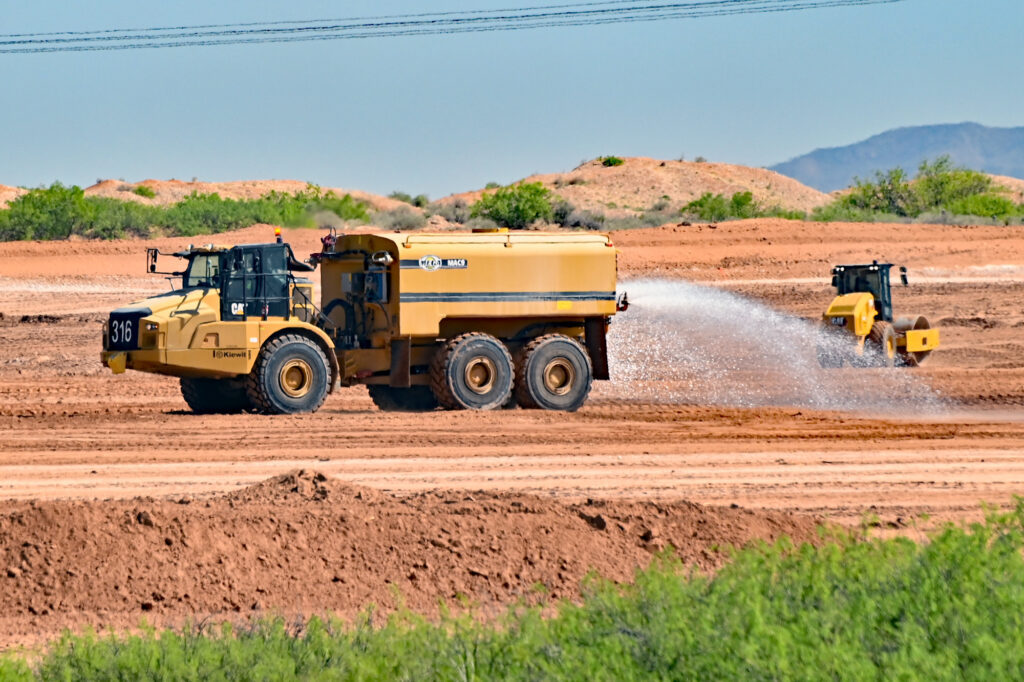
Project Jupiter plans to use nearly a million gallons of water per day, the N.M. Office of the State Engineer says.
That number is almost 50 times more than the project’s developers have disclosed publicly and does not appear to be consistent with language they share with the public on their website. At least one Doña Ana County commissioner who was involved in negotiating a legally binding pledge of low water use says he will hold the developers to that promise.
“My prior commitments still stand,” Commissioner Christopher Schaljo-Hernandez said. “We will be holding them accountable.”
The new number first appeared on Tuesday in an article published by The Santa Fe New Mexican. In that report, the state engineer’s general counsel, Nat Chakeres, was quoted as saying Project Jupiter’s two gas-fired power plants require nearly a million gallons of water per day. In water terms, that’s about 1,100 acre-feet per year.
Months after construction began, Project Jupiter remains highly controversial. That’s largely because the developers have asked for the ability to emit about 13 million tons of greenhouse gases per year.
That is roughly equivalent to the average annual emissions of 3 million gas-powered automobiles, according to an estimate of emissions from the Environmental Protection Agency. A decision on the air quality permit applications is pending.
Developers don’t confirm or deny amount
The new water claim from the Office of the State Engineer (OSE) has the potential to increase the controversy. The county’s legal agreements permit Project Jupiter to use 20,000 gallons of potable water per day, with a maximum at peak use capped at 60,000.
I asked OSE how it learned Project Jupiter planned such high water use, given that the claim doesn’t match what has been disclosed elsewhere.
“These estimates are based on conversations with Project Jupiter’s representatives,” spokeswoman Maggie Fitzgerald told me. “The OSE approached Project Jupiter and asked about its projected water needs, and these are the numbers and sources we received.”
Oracle, one of the developers of the campus of advanced artificial intelligence data centers in Santa Teresa, confirmed in a statement provided to me and The New Mexican that they plan to use some non-potable water for “construction and cooling systems at the microgrids and data center.”
Inclusion of the microgrids in that list is new. In responses to questions submitted by county Commissioner Gloria Gameros last fall, the developers said they were looking at water sources such as “non-potable or brackish wells” only for construction and to fill the closed-loop cooling system for the data centers.
The developers did not answer some other questions I asked on Tuesday, including whether they plan to use nearly 1 million gallons of water per day.
I asked several folks to help me understand the legal difference between potable and non-potable water, especially given that the county is planning to build a desalination plant to make brackish water drinkable. Some folks weren’t clear, and Oracle didn’t provide a response to that question.
Buying water from a sod farm
The OSE got involved in October, when the owner of a sod farm near where Project Jupiter is being built filed an application with that agency to drill an emergency well. With some of the company’s wells failing, the remaining two could not sufficiently supply water to the sod farm and a “large-scale industrial project,” Gilbert G. Mesa wrote on behalf of that company, Santa Teresa Capital LLC, in an Oct. 21 letter to OSE.
Without a new well immediately, “the large-scale industrial project (which is a priority project for the State of New Mexico and Doña Ana County), will suffer serious economic loss due to delayed construction schedule and related impacts,” the letter stated.
The OSE allowed the emergency well. It received 32 letters of protest, so it will hold a hearing later this year to determine whether that decision was appropriate. A date has yet to be set.
Project Jupiter’s developers publicly acknowledged months ago that they were purchasing water from the sod farmer. At an October meeting of the Doña Ana County Planning and Zoning Commission, the disclosure came from Jennifer Bradfute, a consultant for BorderPlex Digital Assets, one of Oracle’s partners in the project.
“Right now, some the initial water is actually going to be brought over by a temporary line from a water-rights holder,” Bradfute said. “We’re purchasing water from a sod farm nearby, and they have excess water that can be used.”
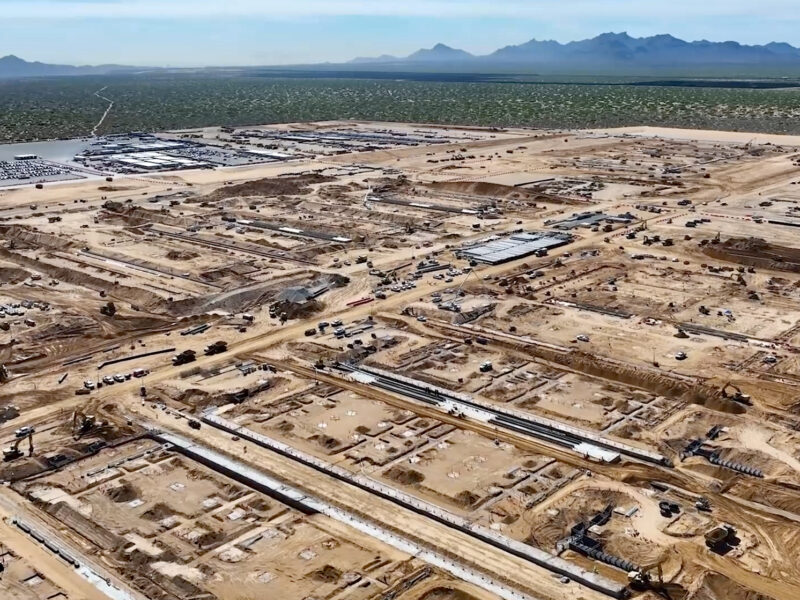
Around the same time, heavy equipment was just beginning to level earth at the project’s primary, 1,400-acre construction site.
The developers have publicly promoted their use of a closed-loop system to cool electronics in the data centers, which would reduce water use dramatically and made their pledge of an average daily use of 20,000 gallons possible.
In a February blog post, Oracle made another apparent reference to the sod farm, disclosing that the “initial fill” of the closed-loop system “will be made with non-potable water drawn from existing commercial water rights.”
But that fill and construction are one-time uses. County officials didn’t see them as conflicting with the legal promise related to daily water use once the data centers and microgrids go online.
Trying to understand ‘a constantly moving target’
Now, Oracle is confirming that the cooling systems for the microgrids will also use water from the sod farm. And if OSE is correct, that use is apparently no longer temporary.
The possibility rankled opponents and supporters of Project Jupiter alike.
“I would like Project Jupiter’s developers to explain this situation publicly and fully, which they are currently refusing to do,” said state Rep. Sarah Silva, who has supported the project. (Disclosure: Silva is this reporter’s spouse.)
State Sen. Jeff Steinborn, who unsuccessfully pushed legislation to regulate microgrids like Project Jupiter’s in the most recent session, said the project’s “through line” has been “a constantly moving target and a concealment of the full scope of the impacts of the project.”
“It’s all just shocking and makes the lack of preventative governmental policies, at frankly both the local and state level, all the more disappointing,” Steinborn said.
County Commission Chairman Manuel Sanchez, a supporter of the project, said he had reached out to the OSE to try to learn more about its claim. He echoed Steinborn’s frustration with Project Jupiter’s developers.
“It seems like it’s a moving target and we’re not being told what the real information is,” Sanchez said. He placed blame with BorderPlex Digital, saying “as things are changing, they are not communicating, at least with the county commissioners.”
“We’re the ones that supported it and we’re the ones being left out to dry,” Sanchez said.
State Rep. Micaela Lara Cadena, one of Project Jupiter’s most vocal opponents, said she was grateful to OSE for confirming something she has suspected since she learned about the sod-farm deal last year.
“The more we learn, the more we realize these deals were made with dishonesty and deceptive practices,” Cadena said. “New Mexicans deserve to understand the real impact, from the jobs to the emissions to the water usage — but these entities keep playing fast and loose with the truth.”
‘Way too many straws in the aquifer’
Silva said the news from the OSE “shocked” her. Coupled with the city of El Paso permitting a Meta data center being built near the state line south of Chaparral, N.M., to use up to 1.5 million gallons of water per day, she said the possibility of Project Jupiter using almost a million gallons daily “raises serious, long-term questions about whether we have enough water to meet the basic needs of our communities.”
Cadena, one of Project Jupiter’s most vocal opponents, also expressed concern about the region’s water future. She pointed to the pending settlement in New Mexico’s legal battle with Texas over water use.
Assuming the U.S. Supreme Court approves that settlement, New Mexico will have to purchase more than 18,000 acre-feet of water rights in the lower Rio Grande, south of Elephant Butte, and retire them. Cadena said that will mean buying out farmers, and if the news about Project Jupiter is true, officials will simultaneously be allowing lots of water to be used for a new industrial project.
Norm Gaume, president of the nonprofit New Mexico Water Advocates, said allowing Project Jupiter to use so much water “just seems crazy” when the lower Rio Grande region is already facing what’s called “water bankruptcy” — the concept that a region has so depleted its water that some damage is irreversible on human timelines.
“There are way too many straws in the aquifer now,” Guame said. “The straws are going to have to be decreased, and we’ve got a proposal for a great big new one.”
The Oracle statement defended the purchase of water from the sod farm, saying the farmer’s total use, including what’s going to Project Jupiter, “remains below historical withdrawal levels.”
“Simply put, we are reallocating existing water usage, not increasing demand,” Oracle said.
Fitzgerald, the OSE spokeswoman, said the state engineer “is concerned about any increase in depletions in the basin. That is why any additional water use must fall within the withdrawals allowed under existing permits.”
‘Put the brakes’ on data centers
Gov. Michelle Lujan Grisham first announced Project Jupiter in February 2025. Quick approvals followed. Construction began in late September or early October.
I visited the construction sites in Santa Teresa last week. I was denied access to the primary site on the southeast corner of Pete Domenici Highway and N.M. Highway 9. But a mile west on Highway 9 you can see construction of what’s called “West Microgrid” from the road.
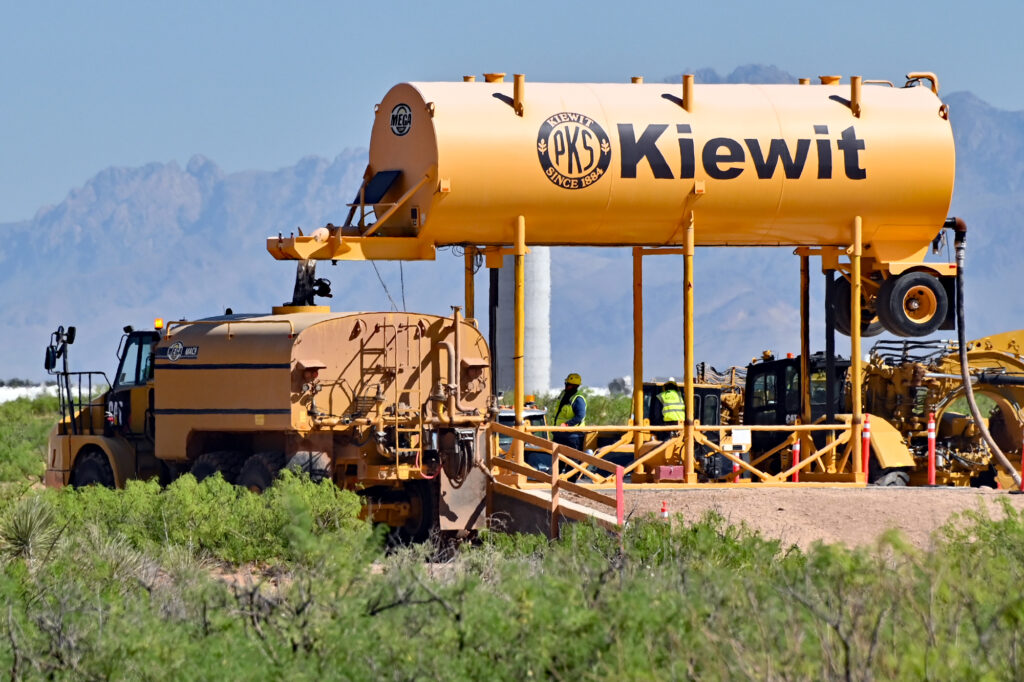
I stood there for an hour photographing heavy equipment moving massive amounts of earth on the construction site, which spans several hundred acres. I watched trucks spray the ground, apparently with water from the sod farm. Several times I saw trucks pull up alongside a raised water tank for refills.
I tried to picture the massive power plant the developers plan to build there.
The Lujan Grisham Administration has been openly courting new data centers. The news about Project Jupiter prompted Steinborn to call for the governor to “put the brakes” on those efforts.
“Today’s announcement once again underscores the negative impacts of an unregulated and out-of-control data-center industry being recruited into New Mexico,” he said.
I emailed Lujan Grisham’s office for comment but received no response. The governor is in Spain on official business.
‘We all deserve the answers’
Schaljo-Hernandez said the county’s understanding all along has been that Project Jupiter would use an average of 20,000 gallons of water per day for all operations, “and that’s still a commitment we’re going to hold them to because that’s what the commission approved.”
On Tuesday, as I reported for this article, Project Jupiter’s website included language that has been there for months. “We can confirm that the daily operational water use for the full data center campus buildout will be an average of 20,000 gallons per day with a maximum peak use capped at 60,000 gallons per day,” it states in one section.
“Project Jupiter will: Limit water use to the domestic needs of employees,” it states in another spot.
The water-use promise is in a complex legal agreement between the developers and the county that authorized a 30-year exemption from paying property taxes in exchange for $360 million in direct payments and other pledges.
Enforcement, should the county decide the developers are in violation, could come in the form of a lawsuit.
Schaljo-Hernandez said he takes the water-use promise in that agreement “very seriously.”
“There’s a lot of questions, and I think we all deserve the answers to those questions,” he said.
AN ASK: I’ve worked tirelessly to watchdog Project Jupiter since the beginning. If you value such journalism, please, support my work by making a donation or signing up to make monthly contributions. Thank you!
DISCLOSURE: In case you missed it earlier, state Rep. Sarah Silva, who is quoted in this article, is my spouse.
Irrigation wells are considered non-potable because they are not built to potable water standards. They often pull from shallower aquifer levels which are more susceptible to contamination. They are not required to have a 40′ surface seal like the potable wells. There are other differences in surface construction. However, they are pulling from the same aquifer as potable wells and they can impact wells in the surrounding area.
Thank you for educating me!
If supporters haven’t figured it out by now, we are being played! This group pushing this Ponzi scheme is not to be trusted – period! And Steinborne – you’re a joke. You and Nathan Small buddied up on this playing good cop bad cop. Nathan is the crux of the biscuit. I see he played a huge part in your wedding too, probably why his name hasn’t been dragged into this.
Come on, man. I was moving very fast yesterday and focused my time interviewing and quoting the people I could get to talk with me. I think it’s impressive I got almost all of the biggest players on the record. I worked 16 hours straight yesterday to get this story out.
I have no problem writing about Rep. Small. The reason you know he performed our wedding is that I disclosed it in an article when I wrote about him, which should prove that point.
No knock on your article, I just wanted to emphasize Nathan Small as a huge reason for getting us into this mess. Steinborne makes it into the news for “trying to fix things through legislation” and gets pegged as the good guy. Writing previously about the wedding is good disclosure, but the media leaving his name out of this conversation is detrimental to the credibility of the entire legislature. Again, these guys are both playing us with the good cop/bad cop shtick. If you start writing about how bad a leader Small is (supporting PNM buyout another example) then that would certainly put negative pressure on the relationship between you, Silva and Small, which I’m guessing you would rather avoid. I’m hoping another journalist picks up the story. Not a personal attack on you Heath, just bringing to light some facts that are important to recognize.
As always, I appreciate the feedback. I disclose potential conflicts specifically to hold myself accountable to journalistic standards, and you’re welcome to hold me to that standard as well. You have strong opinions about Rep. Small and Sen. Steinborn, which is totally fine, but with this article I was looking for opinions from some of the most prominent supporters and opponents to help people understand how this news might impact the situation and to take the temperature of things. I got who I got on the phone. I quoted who was willing to be quoted. And then I moved on to the next call. I had a lot of work to do yesterday. I certainly wasn’t trying to downplay Rep. Small’s support for Project Jupiter.
Sufficient additional water will not be ‘created’ to meet the needs of agriculture, industry, cities and growing populations. Nature is providing the water, and nature does not sign agreements. Isn’t sufficient water for living things the top priority?
That’s the right question to be asking. I think that’s why so many supporters and opponents of Project Jupiter are finding some common ground on this issue.
Count me as one of the “supporters” who feels betrayed.
I was wondering! Thanks for weighing in, Jim.
Do you know when/where the public hearings on Jupiter will be held?
Haven’t been scheduled yet.
Jim, your public comments this week were on point. Your support for PJ always confused me but it’s never too late to express your concern for this bait and switch Ponzi scheme. Check out how the Imperial Valley CA data center vote just went down this week. Similar tactics we saw here, although pushed to the extreme. Read the new investigations into Sam Altman; he’s not the kind of person NM should be supporting, same as Zuckerberg. I’m all for jobs, but data centers and AI are wiping out the jobs market at an alarming rate.
Concerned Citizens
Was an Environmental Impact Statement dine???????
Environmental Impact Statement done.
Environmental site assessments were done by the company, but not released to the public before the county commission votes, and an independent environmental impact report was not done.
Dig deeper Heath!!!!! EIS was submitted by the developers, but is ON RECORD that the study is not valid! The report is only a surface level visual site survey and was done by a Texas based company that WAS NOT an approved vendor by the state of NM. This was revealed during the P&Z meeting back in October and was COMPLETELY glossed over by P&Z!