 Heath Haussamen
This is a breaking news article. Check back Friday for the audio version.
The developers of Project Jupiter plan to use more water than Doña Ana County believes they had agreed upon, and also more than they previously disclosed to the public.
How much more is a question the developers aren’t answering. As I reported on Tuesday, the Office of the State Engineer said Project Jupiter needed almost a million gallons of water per day, which is about 50 times more than county officials believed they agreed to use.
I have been unable to independently verify that number.
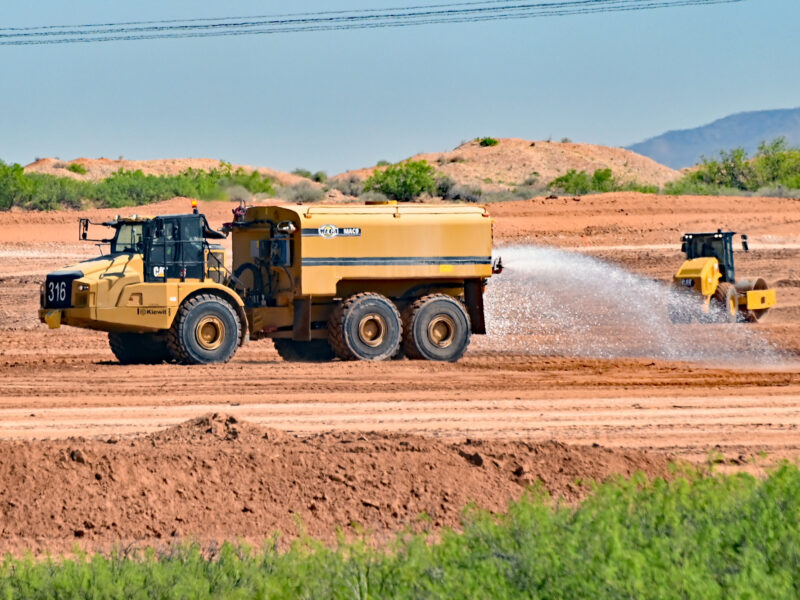
Regardless, Oracle, one of the companies behind Project Jupiter, confirmed Thursday that the developers plan to use non-potable water piped in from a nearby sod farm for their power plants. That’s in addition to the average 20,000 daily gallons they plan to draw from the area’s water utility, which they say is for employee use.
Two county commissioners, Manuel Sanchez and Christopher Schaljo-Hernandez, insisted in December that the 20,000-gallon limit covered the full campus of advanced artificial intelligence data centers that’s being built in Santa Teresa, including the power plants, which are called microgrids.
County officials knew the developers were using water from the sod farm for construction and an initial fill of the closed-loop cooling system for the data centers. But a representative of the developers told the county’s Planning and Zoning Commission in October that the water line from the sod farm was “temporary.”
Sanchez, the chair of the county commission, confirmed Thursday that county officials believed use of the non-potable water would stop when construction was complete. So the newly revealed plan to use that water for the microgrids is significant.
“We’ll have to evaluate and understand what changes have occurred and determine our next steps,” Sanchez told me.
How we got here
Data centers have historically used immense amounts of water, but Project Jupiter’s developers promised to be different. The agreement county officials believed they secured made Project Jupiter stand out from others largely because of its pledge of low water use.
The developers have applied for air quality permits to operate their own gas-fired power plants that would allow them to emit an immense amount of greenhouse gasses — up to 13 million tons per year.
That’s a primary reason Project Jupiter remains highly controversial months after construction began. So the potential that it might also use a massive amount of water, especially in a region where scarcity is a serious concern, could cause support to fall further.
The developers entered into a complex legal agreement with the county last fall that gave them a 30-year exemption from paying property taxes. In exchange, they agreed to make $360 million in payments to the county and made other promises.
Among them was this commitment on water use: “The daily operational potable water use for the full data center campus buildout will be an average of 20,000 gallons per day with a maximum peak use capped at 60,000 gallons per day.”
Potable water means water that is safe for drinking. That word was not the version of the agreement commissioners voted to approve in September. But as part of that Sept. 19 vote, commissioners gave then-Chairman Schaljo-Hernandez authority to finalize the agreement in secret.
When he signed it weeks later, the total number of pages had grown from 359 to 1,583. And the word “potable” had been added.
Now we know what the developers plan to do with that change.
“Project Jupiter’s use of community drinking water is limited to an average of 20,000 gallons per day,” the new statement from Oracle read. “The water used for construction and cooling systems at the microgrids and data center is unfit for drinking and comes from existing allocated, commercial non-potable sources.”
‘A good path going forward’
The county may not have the authority to stop Project Jupiter from being built. And it’s not clear from the legal agreement that it can limit Project Jupiter’s use of non-potable water.
But if county commissioners believe the developers violated their property-tax agreement, they could sue to try to undo that deal.
If successful, that could allow the county to assess the developers property tax over 30 years, which would likely be far more than the $360 million in payments they’re set to receive.
But such action could also void other parts of the agreement, including the limit on potable water use. Or it could prompt the developers to abandon the project.
In other words, the path forward may be complicated. As an alternative to a lawsuit, the county could attempt to negotiate limits on Project Jupiter’s use of non-potable water or other new agreements.
County Commissioner Susana Chaparro, who voted against Project Jupiter’s tax breaks last year and sharply criticized the process that led to the deal, said the county now finds itself in “a tough situation.” She said negotiations, provided they include all five commissioners, may be “a good path going forward.”
Public promises
It’s not clear to me how much water the developers might use to cool the microgrids. What is clear is that they didn’t share that need with the public while the county was considering the deal last fall.
Commissioner Gloria Gameros asked a number of questions during that time. The developers responded, in a document circulated to the public, by pledging to limit “daily operational use” to an average of 20,000 gallons of water. They also said they would use “alternative sources such as non-potable or brackish wells” for “construction and one-time system cooling fill.”
They gave no indication that operation of the microgrids wasn’t included in the estimate for “daily operational use.”
Similar language remains on Project Jupiter’s website to this day: “We can confirm that the daily operational water use for the full data center campus buildout will be an average of 20,000 gallons per day with a maximum peak use capped at 60,000 gallons per day.”
Unlike the legal agreement, the website does not include the word “potable.” Instead, it appears to promise to broadly limit all water use.
‘These numbers are staggering’
Of course, what’s in the legal agreement is what counts. So I went elsewhere to try to get a sense of how much water we’re talking about. Will the developers really use close to a million gallons per day, as the general counsel in the Office of the State Engineer (OSE) says he was told?
I don’t know. That office’s spokeswoman, Maggie Fitzgerald, told me Thursday that a Project Jupiter attorney shared that number with general counsel Nat Chakeres during “an informal conversation” in February. I asked for any documents to back up the claim. “No documents were sought or provided,” Fitzgerald said.
I asked if the OSE had a copy of the contract between the sod farm and Project Jupiter’s developers. “We do not,” she said.
I reached out to an official with the company that owns the sod farm, Santa Teresa Capital, to ask about the deal. “I’m not at liberty to talk about it,” Gilbert G. Mesa told me. When I mentioned that I knew Project Jupiter’s developers were requiring business partners to sign non-disclosure agreements, he said, “Yes, sir.”
One million gallons per day is about 1,100 acre-feet per year in water terms. The sod farm is permitted to use up to 2,500 acre-feet per year for commercial purposes, online records indicate. That’s more than 2.2 million gallons of water per day.
Estimates of household water use vary, but a million gallons of water per day would supply somewhere around 3,000 homes. And according to New Mexico State University, it would be enough daily water for 4,000 or more mature pecan trees at peak seasonal heat.
“These numbers are staggering,” said state Rep. Micaela Lara Cadena, one of Project Jupiter’s most outspoken opponents. “We already are living through a scarce water reality that we know is getting worse. It’s important that we continue to have a public debate about depleting our already scarce water resources.”
Many other data centers are using massive amounts of water. The city of El Paso, Texas permitted a Meta data center being built near the state line south of Chaparral, N.M., to use up to 1.5 million gallons of water per day. That city says it expects average daily use to be closer to 400,000 gallons.
Oracle didn’t answer my question about how much non-potable water Project Jupiter plans to use. But it said the sod farm’s “combined water use, inclusive of Project Jupiter’s contracted volumes,” is lower than what the farm has used historically.
“The project reallocates existing water usage while not increasing demand,” Oracle said.
‘We as a county have to step up now’
Oracle shared the new details only after several local elected officials — opponents and supporters of Project Jupiter alike — expressed frustration following the claim from the state engineer’s office and demanded that the developers release more information. Those officials included Sanchez, who told me earlier this week that details about the developers’ plans remained “a moving target.”
Several months ago, Sanchez spoke with me about his work to ensure Project Jupiter’s promises made it into legally binding agreements. He said he had listened to feedback from community members and worked to ensure the developers were not just making “statements to appease.”
The burden, he said in October, would be on county government to hold the developers accountable. “Speaking for myself, we as a county have to step up now and ensure that happens,” Sanchez said.
Six months later, it will be interesting to see what county commissioners decide to do.
Oracle’s full statement
Here is the full statement provided by Oracle:
“Project Jupiter’s use of community drinking water is limited to an average of 20,000 gallons per day. The water used for construction and cooling systems at the microgrids and data center is unfit for drinking and comes from existing allocated, commercial non-potable sources. Our total usage is essential to support advanced emissions control technology that improves local air quality. The rights holder’s combined water use, inclusive of Project Jupiter’s contracted volumes, remains below historical withdrawal levels. The project reallocates existing water usage, while not increasing demand.
“Actual water use will decrease during the colder months and in off-hours when utilization of the data center and microgrid decreases. Most importantly, our $50 million investment to improve the local public water system will help ensure safe, reliable drinking water for all residents.”
AN ASK: I’ve worked tirelessly to watchdog Project Jupiter since the beginning. If you value such journalism, please, support my work by making a donation or signing up to make monthly contributions. Thank you!
DISCLOSURE: State Rep. Sarah Silva, a supporter of Project Jupiter, is my spouse.
Well, the ‘cat is out of the bag’. At this time, reviewing the agreement langusge clearly shows the effort to present incomplete and deveptive statements in order to get approval. They got the approval they wanted. The defence will be: it’s good for economic developement and the good outweighs the bad.
Remember, essentially all water, potable or non-potable, comes from nature and nature is limited. Protect life!
Thanks for weighing in, Fred!
1. Structurally dry—and getting worse
https://s.w.org/images/core/emoji/17.0.2/svg/1f449.svg This is not a temporary drought. It’s what scientists call “aridification”—a permanent drying trend.
2. Southern NM is especially vulnerableThe area around Doña Ana County / Santa Teresa / Sunland Park (where Project Jupiter is proposed):
3. Ongoing shortages are already affecting people
What the project says
What critics point out
4. Supply risk
5. Regulatory risk
That tells you this is politically and environmentally contentious.
6. Credibility gap
water is the central political and environmental fault line—and could ultimately decide its fate.
I