 Heath Haussamen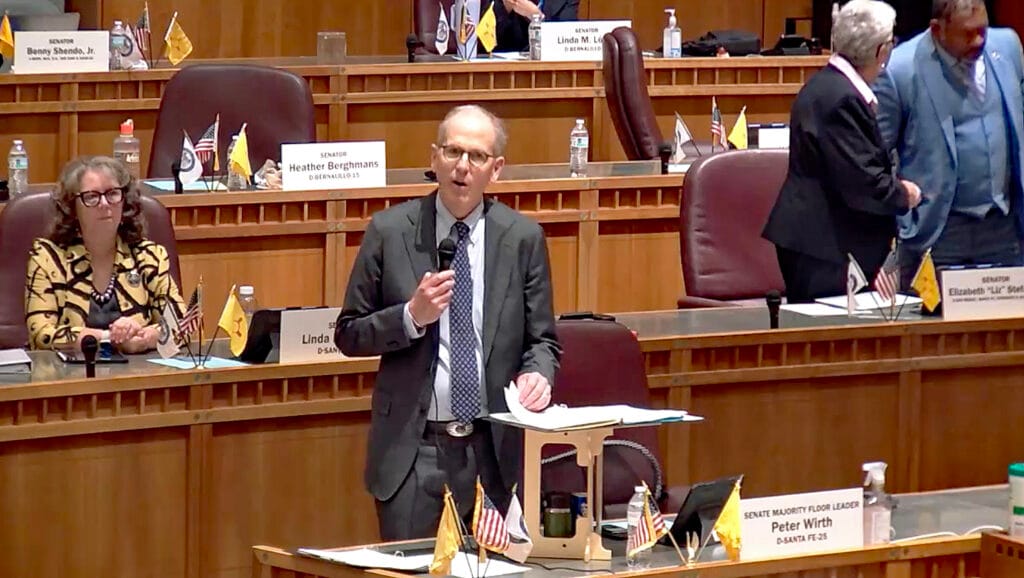
With the current shutdown highlighting how reckless and callous the federal government has become, New Mexico is getting more assertive about charting a course forward.
The N.M. Legislature is currently meeting in special session to protect people who are put at risk by federal funding cuts and allow the state to set its own vaccine policy, among other things.
And the Las Cruces City Council is set to vote Monday on a lengthy resolution intended to protect immigrants without legal status and others who are being targeted by the federal government.
The state House and Senate convened Wednesday and quickly advanced legislation. Representatives approved House Bill 1, which would provide nearly $30 million in food assistance for New Mexicans, $17 million to continue subsidies the federal government is no longer providing to help with folks’ health-care premiums, and $6 million to help replace funding for public radio and television stations that the federal government cut earlier this year, among other things.
The legislation also frees up $50 million for the Rural Health Care Delivery Fund for providers who are impacted by shifts in Medicaid and other federal funding.
House Appropriations and Finance Committee Chairman Nathan Small, D-Las Cruces, spoke during Wednesday’s floor session about health-care costs for New Mexicans that, because of federal changes, are set to spike “without our action.” He also mentioned 30,000 seniors who are set to lose monthly food benefits.
“We are in a changed world,” Small said.
Senate Majority Leader Peter Wirth, D-Santa Fe, said in a news release that the state is in “a strong financial position to fight back against federal funding cuts and protect the services that New Mexicans need, while continuing to invest in our future.”
“New Mexico is ready for this moment,” Wirth said.
Resolution affirms ‘immigrant-friendly status’
Meanwhile, city councilors in Las Cruces are set to vote Monday on a resolution aimed at protecting folks from incursions by federal agents who are looking for people to deport.
The resolution, which states that Las Cruces “affirms its immigrant-friendly status,” aims to build on previous moves by the city. It references Las Cruces Police Department Order 165, which requires police to protect folks’ constitutional rights and treat everyone equally during enforcement actions, and Order 166, which prohibits police from inquiring about an individual’s immigration status without a valid judicial warrant.
New in the resolution are several provisions:
• It would ban the use of city resources to assist federal immigration agents or enforcement against anyone for exercising their First Amendment rights to speech, assembly and petitioning the government unless required by law.
• “Sensitive personal information” such as government identification numbers, home addresses and immigration status would be protected, meaning no city official would be allowed to “request, maintain, share or distribute” such information. City departments would only be allowed to utilize such information if necessary to perform that agency’s duties. The city would conduct quarterly audits to document requests for information related to immigration enforcement and to identify any “vulnerabilities” in the city’s sharing and storage of such information. Findings would be reported to the City Council.
• The city would identify areas in its buildings that are not public and affirm that immigration and other law enforcement agents need a warrant signed by a judge to enter such areas. City staff would be trained on that policy and signs would be displayed.
• The city would allow virtual access to services and court proceedings. The resolution would direct the police department and city attorney to request virtual court options for all traffic citations and misdemeanor arraignments in municipal court. This is likely to help people attend court hearings without the risk of encountering federal immigration agents, who have been waiting at court hearings to detain people.
• When the city receives subpoenas from outside jurisdictions, it would analyze whether they comply with the Fourth Amendment limit on searches and seizures and other constitutional provisions and laws; notify the people whose information is targeted so they have an opportunity to object to such subpoenas, unless notification is prohibited by law; and, for any records produced, redact information that’s “not required.”
• The city would develop a central website that compiles resources for immigrants, “know-your-rights” recommendations and workplace and employer guidance, among other things.
President Donald Trump has repeatedly threatened cities that implement such policies. Some politicians have said cities and states shouldn’t poke the bear. City Councilor Cassie McClure appeared to address that concern in a recent column.
“The more the bear growls, the louder we have to be,” McClure wrote. “The only choice left is whether we stand up to it now or ask for civility as it mauls all those around us before it comes for us, too.”
‘We can get rid of a lot of things’
Meanwhile, the federal government is partially shut down and Congress is deadlocked over a bill to fund it. “A lot of good can come down from shutdowns,” Trump said Tuesday. “We can get rid of a lot of things that we didn’t want, and they’d be Democrat things.”
On Wednesday, Trump’s Budget Director Russ Vought threatened to cancel billions of dollars in funding that was appropriated to lower energy costs for people in several states, including New Mexico.
“On day one of the Trump shutdown, this administration is already treating New Mexicans’ livelihoods as pawns in a political game,” U.S. Sen. Ben Ray Luján, D-N.M., said in response.
U.S. Sen. Martin Heinrich, D-N.M., stated the obvious — even though it’s the opposite of what many Republicans are claiming.
“Republicans control the House, the Senate, and the White House,” Heinrich said. “If they wanted to negotiate a government funding bill, they could. But they don’t.”
Meanwhile, the state House and Senate will continue their work on Thursday. And the Las Cruces City Council will consider its resolution on Monday.
Disclosure: My spouse, state Rep. Sarah Silva, is one of four sponsors of House Bill 1 in the special session.


Heath: One paragraph in your article I do not fully understand. Specifically I refer to the following: “On Wednesday, Trump’s Budget Director Russ Vought threatened to cancel billions of dollars in funding that was appropriated to lower energy costs for people in several states, including New Mexico.”
By funds having been appropriated to lower energy costs for people in several states, including New Mexico, I presume that you mean money having been appropriated to be sent to the states to pay all, or part, of energy bills. I find it interesting that in New Mexico, which is rich in oil and gas production, a state that has massively focused on solar and wind, would have apparently a large number of people who struggle to pay their power bills. Why have not the so called “root” causes of these high utility costs been addressed rather than asking residents of Maine, Alaska, Florida, and all of the other states to assist in the payment of these bills?
Hey Steve! I actually think what we’re talking about are specific solar and wind projects, among other things, that are intended to help with the shift to green energy production and lower the cost of doing it. It’s not money directly going to people’s energy bills.
That said, your question about the reason for high energy prices is a good one!
Here’s an article about what was cut: https://www.santafenewmexican.com/news/local_news/amid-shutdown-u-s-energy-department-cuts-135-million-for-10-energy-projects-in-new/article_592e67ff-e318-4be6-8a48-52d9ae286455.html