 Heath Haussamen
When government officials open a well-attended meeting on a controversial topic with a threat to arrest anyone who doesn’t follow the rules of decorum, we’ve all already lost.
That’s how Doña Ana County kicked off Friday’s meeting of its Board of Commissioners. The meeting ended with a pair of 4-1 votes to approve tax incentives for a project that could become a $165 billion investment in our region over 30 years.
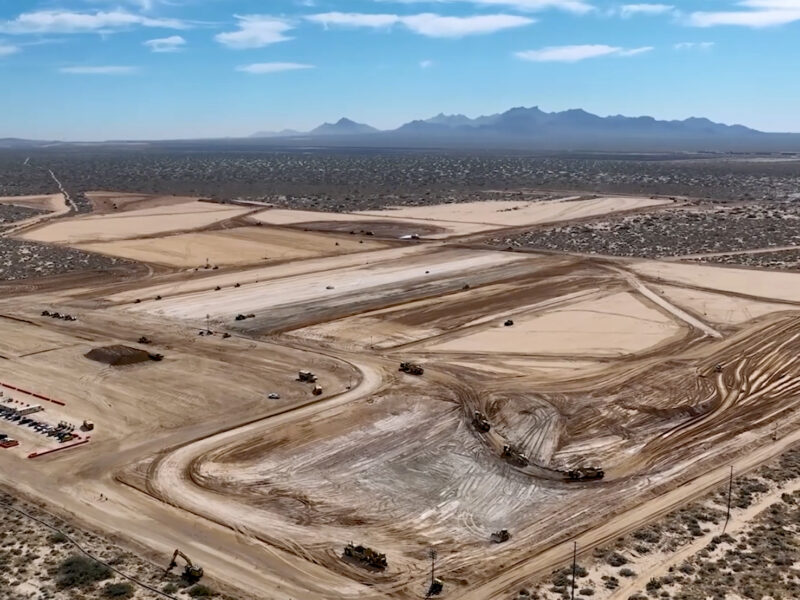
Project Jupiter, the proposed campus of data centers and advanced manufacturing facilities in Santa Teresa, promises economic growth our people desperately need. But it also raises questions about water use and air pollution, among other things.
We still don’t have answers to many of our questions. The massive proposal caught our community off guard. The developers and county rushed through public deliberations.
Hundreds of people showed up to Friday’s meeting. Commissioners listened to hours of public input. I found the arguments for and against the project to be valid, and the discussion to be enlightening.
I don’t know how many others experienced it that way. After nearly a month of frantic efforts to learn about the project and frustrations about secrecy, the meeting was a powder keg.
It opened with the threat by county staffers to arrest those standing in the back of the room if they didn’t find a seat or head to an overflow area to watch the meeting on a screen.
Given recent political violence, I understand the fear that led to a zero-tolerance approach. But the preemptive threat of arrest contributed to the perception that the meeting was a formality, that commissioners had already made a back-room deal with wealthy developers.
It escalated tension. It encouraged resistance.
That resistance was championed by Susana Chaparro, the only commissioner who voted against the tax breaks. She criticized others in county government for the way they handled the process. She repeatedly begged her colleagues for more time to consider the deal before voting.
“I’m missing information, and so is the public,” Chaparro said. She made three motions to delay. Each died without a second.
The other commissioners responded to Chaparro’s pleas with silence. County staff responded to folks’ attempt to bear witness from the back of the room with threats of arrest.
That was the culmination of a rushed, murky process that eroded public trust in county government.
But government officials aren’t the only ones who can learn from this situation. I’ve been thinking about this process in the context of our crumbling democracy. Our collective handling of the debate about Project Jupiter is a microcosm of our larger societal challenges.
We must all commit to being better going forward.
Blindsided
Most of us were blindsided when Doña Ana County announced in late August that commissioners were considering tax incentives for Project Jupiter. I’ve written often in recent months about how systems that support democracy like journalism have eroded. This is a tangible example.
Our government told us this project was coming. Gov. Michelle Lujan Grisham and the chairman of BorderPlex Digital Assets, Lanham Napier, held a press conference on Feb. 25 to sign a memorandum of understanding. The governor sent out a news release. It states that the developers would seek tax incentives from Doña Ana County.
Those documents mentioned nuclear power and other eye-popping things that could have triggered investigation and conversation.
The company hired four lobbyists to influence legislation in the session that ran from mid-January to mid-March. That information was also available publicly.
BorderPlex Digital’s website went live. News outlets from Santa Fe, Albuquerque and El Paso published articles about the project. There was no coverage in Doña Ana County that I can find.
That’s one of our biggest problems: We live in a news desert. As I’ve written, the oligarchs have destroyed local journalism across the nation. They have made it difficult for us to stay informed. Doña Ana County is in an especially bad spot. We’re big enough that important things happen here, but we don’t have enough journalists to tell us about those things.
And no reporters anywhere dug deep into this project until August.
Another flaw, our broken legislative system, let the developers of Project Jupiter win the right, with little deliberation, to generate their own power. After the microgrid legislation failed to advance on its own, it was stuffed into another bill three days before the end of the session with almost no scrutiny.
The vote was public and webcast online. You can go back and watch it now (7:56:30 in this video). I did.
Few lawmakers understood the legislation. Most voted for it anyway.
Throughout this process, the information existed for journalists, community organizers, local elected officials and engaged citizens to ask questions about Project Jupiter and file records requests. We didn’t do that.
I want to say this clearly: I didn’t do that.
Kept behind closed doors
But let’s be really clear: I missed the news about this project. I made a mistake. Some county commissioners and other local politicians, on the other hand, knew about this project. They knew the developers of Project Jupiter would be seeking tax incentives. They could have brought the situation to the attention of the public. They made a choice to let it fly under the radar.
County staff started negotiating on this project in May. They didn’t say anything to the public until they were legally required to do so in late August. Based on what Chaparro and others have said, staff also didn’t tell some commissioners about it until they’d been negotiating with the developers for weeks under the secrecy of non-disclosure agreements.
Like journalists, government has a responsibility to be transparent and facilitate open dialogue. The Project Jupiter process has not met that standard.
Another example from Friday: An hour into the meeting, Christopher Schaljo-Hernandez, the commission’s chairman, proposed moving the meeting behind closed doors to secretly discuss some unspecified thing related to the tax incentives.
Only Chaparro objected.
Commissioners are allowed to meet in private to discuss certain things. But to avoid abuse they’re required by the state’s Open Meetings Act to share why with “reasonable specificity.”
For the Las Cruces City Council, that means naming specific lawsuits they’re discussing. Same for the Las Cruces Public Schools Board of Education. The attorney general’s Open Meetings Act compliance guide directs government boards to do that.
But on Friday, Schaljo-Hernandez read a generic list of reasons the commission might be going into closed session that were included on the agenda: a personnel matter, discussions of property and water rights transactions, and “to discuss information that is covered by attorney-client privilege pertaining to threatened or pending litigation” that wasn’t specified.
Someone in the audience asked for more detail as commissioners were leaving. County Attorney Cari Neill said they were going to discuss “attorney-client privileged matters.” Beyond that, she said, “We do not have to specify what kind of matter it is.”
But state law does require that they be more specific. They can’t go into closed session to chat with their attorney unless it’s to discuss a specific lawsuit or an actual threat of a lawsuit.
In addition creating a potential legal issue for the county, that lack of disclosure was another lost opportunity to build public trust.
The good news
The developers of Project Jupiter are practiced at discouraging public notification and participation beyond what’s legally required. Data centers are controversial, and it’s in the interest of these gigantic, out-of-state corporations to limit public participation. That’s why they insist on non-disclosure agreements.
It would be easy to blame our community’s compliance before late August on county officials for not telling us sooner. It would be easy to blame big corporations like Gannett, which has nearly killed the newspaper that was once the connective tissue of our community, for the difficulties we have staying informed.
Instead, my takeaway is that we have work to do. We have to create the community we want. We have to build and support media that will keep us informed. We have to elect people who will insist on the county government we need.
On that front, there is good news: While we were late to the party, we stepped up. My articles on Project Jupiter represent the deepest reporting I’ve done on anything in this community since I investigated Spaceport America in 2017. Articles I’ve written in the past few weeks have seeped into the public discourse more deeply than anything I’ve written in years.
Other news organizations informed us, too — most notably El Paso Matters.
Community organizers and activists engaged. They knocked on doors, protested, held news conferences and spoke during public meetings.
I’ve seen so many folks, especially retirees with specialized skills, lend their expertise by analyzing Project Jupiter’s plans and sharing feedback.
The developers held public meetings they weren’t planning because Chaparro demanded it. Those events were chaotic and disorganized, but much better than nothing.
We did more than force a public debate. We required the developers to sharpen their plans and make new promises.
There’s a legally binding commitment in the documents commissioners approved Friday, for example, that the developers will donate the first $50 million from their gross receipts tax break back to the county for water and wastewater infrastructure in Sunland Park and Santa Teresa. (Shoutout to my spouse, state Rep. Sarah Silva, for elbowing her way into negotiations and helping secure that promise.)
Once our community became aware of this project, we did all we could to learn, engage and influence the outcome. Though many aren’t happy that commissioners approved the tax incentives, those approvals include legal protections for our communities that would not have existed without our work.
We can’t stop now. With our federal systems and support collapsing, we must build from this moment toward a stronger community.
County government must be better
It’s on all of us, not just our county commissioners, to improve county government’s transparency and responsiveness.
As we headed into Friday’s votes, we didn’t get to see final versions of the agreements commissioners voted to approve. I don’t believe commissioners did, either.
That’s unacceptable. It’s what prompted me to write on Thursday evening that commissioners should delay Friday’s votes. Not giving people the information they need to understand what their government is doing is antithetical to democracy.

I don’t expect elected officials to always vote the way the majority of their constituents want. That isn’t how a representative democracy works, nor should it be. I expect them to become experts on issues and make the best decisions they can.
The offense is the process that led to the final votes, not the votes themselves. Rather than being grounded in relationship with their constituents, county officials made decisions based on the out-of-state developers’ artificial deadline and threat to leave.
“This is a generational opportunity. It is here today,” Napier told commissioners moments before they went into closed session on Friday. “I encourage you to vote for it. A vote to delay it is basically a vote no.”
Next came Chaparro’s first unsuccessful motion to delay. Then the nebulous closed session. It was clear to me, after that series of events, that the meeting would culminate with a majority vote in favor of the tax incentives.
‘I don’t think that’s democracy’
This process began in May with the county manager signing a confidentiality agreement and staff negotiating a deal without the knowledge of some commissioners, let alone the public.
It continued along a short timeline that met the legal requirements for public notification and nothing more, even though this was far from a normal decision. Napier claims this is the biggest private investment in any project in New Mexico’s history.
The process culminated with commissioners voting to approve agreements without knowing for sure what was in those documents.
“I don’t think that’s democracy,” Chaparro said at Friday’s meeting.
Commissioner Gloria Gameros tried to assure everyone it would work out. “We are going to make sure it’s going to be done right,” she said.
Thus far, the evidence suggests otherwise. Thus far, Chaparro stands alone in defending a better public process.
“This has been rushed for me and the people I represent,” Chaparro said Friday. “We need more time.”
The threat to take the project elsewhere appeared to move Commissioner Manuel Sanchez, who I spoke with enough in recent weeks to know he really struggled with this decision. At Friday’s meeting he talked about his own experience growing up here and the need for jobs so our children don’t have to move away after high school or college.

I get it. I also saw many of my friends leave New Mexico after high school. I like Project Jupiter because of its potential, just as I liked Spaceport America when it was being debated. Now the spaceport is paying off, and I hope Project Jupiter will, too.
None of these projects is a game-changer, no matter what Napier says, but collectively they can slowly change our reality.
Regardless, I don’t believe Project Jupiter was ready for approval. I still can’t tell you if some of the developers’ public promises made it into legally binding documents. I’ve filed a records request for the versions of the agreements commissioners voted to approve and will keep you updated.
In working to grow our economy for our children, local governments must also build up democracy. It should be clear now, with the threat of fascism growing, that shoring up our participatory system of government is also critical to our kids’ future.
Going forward
Thinking ahead, I’d like to see us commit to treating each other better. For all the good I saw in the past few weeks, I’ve also seen some folks yelling over and booing each other. I’ve seen personal attacks and racially-tinged cheap shots.
After the commission’s first vote to approve tax incentives on Friday, during a sit-in that temporarily disrupted the meeting, I heard a very loud expletive directed at one of the county commissioners, along with some other unkind things.
I’m a fan of civil disobedience. Frankly, county government earned a disruptive sit-in that filled the commission chambers with chants about democracy.
But I abhor personal attacks. I’d like to see those who are angry point it at the out-of-state developers who insisted on secrecy and gave us an artificial deadline, not on people living our communities who came to a different conclusion than us about the merits of this project.
I want us to channel the energy we brought to this debate into building stronger systems and relationships. We must commit to tenacious watchdogging of our government and civil deliberation with each other.
We can do a thoughtful, nuanced and public cost-benefit analysis every time a proposal like this comes up. We deserved such a process on Project Jupiter.
I’m committing, as a journalist, to do my best. Information is the foundation of community engagement.
You can start by supporting local journalism. Make a donation to me, or El Paso Matters, or whatever news organization you see fit.
We also need stronger community organizing and activism. We need our local politicians and government agencies to know that we expect them to go beyond what’s legally required to involve us in their work.
I believe folks on both sides of the Project Jupiter debate have our community’s best interest at heart. In these strained, violent times, public engagement is difficult. We have to commit to taking deep breaths and being thoughtful.
We don’t have to agree. But at the end of the day, when the debate is over and the developers go back to Austin and Denver, we still have to live together.


You make a lot of excellent points here, Heath, especially about the importance of local journalism and people having a clear idea of what’s actually happening and folks talking and listening to each other instead of scoring points, and I really appreciate the work you’ve put into this series of posts. I’m still an outsider – not moving to LC until next year – but I’m struck by how open the process was for the city council working on the Realize Las Cruces zoning reform (and the vitriol it still attracts on Facebook) and how secretive and rushed the process for Project Jupiter has been. There’s a very big difference between the city council and the county commission, I guess, and the involvement of the sunshine-averse governor’s office doesn’t exactly inspire confidence.
Realize Las Cruces was a good process! Looking forward to having you as a neighbor!
You have provided valuable and necessary reporting, especially in our information desert. Data centers are happening all over the country. Everyone should know that. Big money, big influence, and potentially many poor public decisions are probably commonplace. The arrogance of powerful corporations easily sweeps away any opposition or even allows for informed and open, careful public decision-making. This seems to be the norm. Part-time elected officials are up against an onslaught. Doing the public’s business in the public’s interest and the clarion legitimate call for “transparency,” the favorite and often empty word of our time, is not nearly enough. This grandly named “Project Jupiter” must be put under a community-wide microscopic scrutiny going forward. The County Commissioners should require the County to provide detailed reports on every aspect of this unfolding story in a regular and timely manner. Let that discussion begin.
Thank you!
I wish you had explained to your readers what data centers do and why they are essential to our information age. I wonder how many of your readers know that every time they do an Internet search on their phone, they are accessing a data center. Your phone doesn’t store the Internet. Your phone doesn’t process the search. That’s all done on a server that is housed in a data center. Nearly every app on your phone uses a server housed in a data center somewhere. All your SMS and email is facilitated by a server housed in a data center.
I wonder if your readers understand IRBs and that the exposé DAC and NM to no financial liability.
I wonder how many of your readers understand the difference between evaporative cooling and closed-loop cooling systems.
I wonder if your readers have any idea of the water consumption numbers for Jupiter compared to a pecan farm or a golf course.
I wonder if your readers understand the different gas generation power plants and what Jupiter has committed to for its power generation.
I wonder if your readers have any idea of the economic development process and what it takes to land a multi-billion-dollar deal. I know because I have argued with your readers and they think the state sets the terms for such acquisitions, but that is not the case. We are not the buyer; we are the seller. The buyer can take his money and project to other places.
I wonder if your readers are aware that time is money and investors care less about where they build than they do about how quickly they can build. So the process has to be streamlined, or investors will go elsewhere.
I wonder if your readers understood that a postponement would have almost certainly meant that Jupiter would have gone elsewhere. The deadline was not artificial. Expectations that many minds would have been changed are not founded in reality.
I wonder if your readers knew how hard commissioners worked on this deal and had any appreciation for their knowledge and judgment.The accusations of coruption are dispicable and you have a responsibilty to call those making them to call them out.
There is a lot your readers didn’t know. All you have to do is listen to their comments at the commission meeting to understand the depth of their ignorance.
The county is fortunate that the decision was entrusted to the commission and not the general public, as represented by the opposition. The portion of the public who, in this case, have strong feelings and weak knowledge.
Good try. A month postponement would not have had the corporate raiders walking. It takes too long for them to start over. But it raises a huge red flag about what they buried in the paperwork and NDAs to put such pressure on the local country bumpkins. I wonder if you know that data center jobs are for the highly educated, not for the majority of poorly educated unemployed in Cruces. Look at las Lunes where Google imported their Silicone Valley professionals, with their inflated salaries, jacking up home costs that have made it impossible for locals to find affordable housing. The slick carpet baggers preyed on your fear and you caved. In Deming 2001 the story played out the same way with the Duke Energy Luna Power Facility. Results: No new job for locals. Water use equal to half the county municipal water supply, 2 million gallons per day, depleting our only water source that has seen a 30% reduction in 50 years with no recharge in 20 years. But go ahead and act all wise because you have some computer science background.
This argument facilitates kleptocracy.
Your thought process is thick with paternalism. And other isms that are disgustingly prevalent in today’s society that are not needed to be discussed here.
Because the common man is too stupid to understand how to make money, how to understand technology, and how to find their voice for the public sphere, They have no right to be heard? They have no right to exist? They have no right to disrupt those who know so much?
Hide the information from the people? Don’t Let them have a chance to be informed? There are going to be naysayers no matter what you do?
Buddy I don’t know what country you’re from, but that’s the American way. Have you ever heard that slogan No Kings?
That sentiment applies to people like you too. There are plenty of people out here in the community who have read everything they could get their hands on, mostly because of Heath’s reporting.
I can’t even begin to describe how your high and mighty attitude of sanctimonious hubris pisses me off.
Jim Hoerst, I hope you read the part of this column where I called for more kindness, and I’d ask you to take it to heart. Explaining away people’s disagreements with you as ignorance is not the kind of benefit of the doubt and kindness I’m looking for, to be honest.
Frankly, I’m a little surprised at how much faith you place in the developer’s public promises that aren’t backed up by any legal agreements, especially given your recent pushback about another type of faith in public places. Some of the things you state as fact are public promises that are not backed up with legal guarantees, and yet you assert those as fact and claim that folks who don’t see that are ignorant.
I disagree.
To address what you said in another comment elsewhere, I did not give more time in my reporting to opponents of Project Jupiter than supporters. I devoted nearly all of my time to obtaining documents and reporting facts. To the degree that I did quote people instead of documents, the only person I quoted who voted against the tax incentives was Commissioner Chaparro, and her opposition was about procedure, not the project itself. I regularly quoted two commissioners who voted for Project Jupiter, in addition to county staff and employees of BorderPlex Digital. I gave a lot of space to the people who are trying to make this project happen.
To address a few things you said in the above comment:
– I did report on what an IRB is and that it does not expose government to financial liability.
– I did report on the company’s claim it would use a closed-loop system (which, as far as I know, is not required by an legal documents).
– I did report their claims about how much water they planned to use (which, again, is not a legal requirement in any document as far as I know).
– You can streamline the process, but not in a way that violates state law. And if you do it in a way that alienates your voters, you’re in trouble.
– Finally, I’d say that this process was designed to be secret and exclude the public, and most of it happened in secret. To the degree that people don’t know what they’re talking about, I believe the process set them up for that. Frankly, Jim, as I’ve pointed out in a couple of points above, you don’t have all of your facts right, either. With all due respect, I’m still surprised at the way you’re repeating corporate talking points as though they’re fact when they aren’t in any legal agreements.
I’m not criticizing anyone for still learning about this project. I’m still learning about it too. That is a symptom of the poor process we’ve all just gone through. It wasn’t intended to inform us. Our commissioners hadn’t even seen the final versions of the documents when they voted to approve them last week. You mention the public having very little knowledge. Same is true of our commissioners. That’s the problem I have with this.
Again, I’d ask for a little more kindness for people who live in this community with you who aren’t on your side on this issue.
Thanks.
James,
I wonder if _you_ are fully aware of the potential impacts, since your post is written in such a dismissive style.
As a resident of Santa Teresa and a software developer for almost 30 years (last 15 of which in the telecom sector) who has worked for some of the largest corporations in the U.S., I know a thing or two about dealing with data centers and technical sales people. And I know how to recognize “sales-speak”.
I opposed the project since I became aware of it _because_ of my knowledge and background. I attended one of these meetings with an open mind, but what I heard was greatly disheartening. In my line of work, we say “it’s better to not make a deal than to make a bad one”, and this did not seem like a good deal to me for this area.
Closed-loop cooling systems are more water efficient, yes, but the whole “one-time fill-up” is a fallacy. Even closed loop systems will have some loss, and over time the water used breaks down on its efficiency as a thermal conductor due to the repeated cooling/warming cycles and will have to be completely replaced. The water also has to be treated with chemicals that will practically make it useless for other purposes in the future. It was telling that at these meetings the developers didn’t want to disclose even a ballpark figure of how much it was until the public became angry. And the arguments about pecan farms and other comparative uses are just whataboutism in my book (I oppose such uses as well, for the record).
In addition to that, the region already has problems with air quality due to the industrial park nearby. So much so, that I’ve personally had friends move away from the area because they were concerned for the health of their kids. Burning a ton of fossil fuels will only worsen the situation.
So these concerns are valid and require extreme scrutiny. You cannot drink dollars or breathe jobs, so you shouldn’t sacrifice the environment in the altar of capital.
Unfortunately, I anticipate many of these “nice” jobs will not go to Doña Ana county residents in the end but rather folks from El Paso or Ciudad Juarez, negating any state income tax that could be collected from them. When I moved here, the company I worked for at the time opened a large site with hundreds of engineers and struggled to find the talent locally, so they pulled the talent from the entire surrounding area with in hundreds of miles and were still struggling. At the meeting I attended there was a gentleman with 5 kids, very frustrated that he had to drive far away to find jobs, and I greatly sympathized with him. But some part of me wanted to ask him: “do you know any of the dozen or so technologies you need to get one of these nice jobs? Because if not, get back to school now and by the time they finish building this you may be ready.”
Yes there may be add-on economic benefits, but the whole process has had a whiff of either corruption or ineptitude so the whole “shut up and trust the government” attitude is not something I’m comfortable with.
Thank you for sharing your experience and opinion!
My county commissioner, Shannon Reynolds, has just lost my vote and support. Projects that are shrouded in secrecy, NDAs, backroom meetings and then steamrolled over the public need for deliberation and debate can’t be good.
And, the point concerning the lack of local news reporters and published news is concerning. I stopped our subscription to the Sun-News when Walter Reubel was let go. The News was basically all about El Paso with a page of Las Cruces high school sports added.
Heath, thank you for keeping us informed about this significant issue. You are correct about Gannett. They have gutted newsrooms and decimated their local papers’ ability to inform the public properly. That’s why independent voices like yours are so needed. Keep up your excellent reporting work.
Thanks! I’ll do my best.
Thank you for this sincere and comprehensive overview of Project Jupiter. Neither Dona Ana County nor El Paso are ready for this massive project. Such an undertaking should have been introduced and discussed for months in public forums, allowing the public to form informed opinions. Instead this nightmare was literally rammed down the throats of DAC residents, and they were ill-equipped to rationally react.
The Chihuahua desert is a fragile environment. It can only tolerate so much before it simply decompensates. Do we want to become the next Phoenix or Mexico City? Desalination of the vast ocean beneath our feet is only a theory and fraught with known and unknown consequences.
We need to accept that there are limits to rational development. This is nightmare project looks great to the politicians in Santa Fe – if it is placed far south and away from the Governor’s haunts. She gave the marching orders to the DAC BOCC and they fell in line.
There is still time to step on the emergency brake. Let these oligarchs take their project elsewhere.
Thanks for sharing your opinion, Bob!