 Heath Haussamen
THE DOCUMENTS:
• Doña Ana County’s NDA with BorderPlex Digital
• Doña Ana County’s NDA with Stack Infrastructure
PREVIOUS COVERAGE:
• Project Jupiter commits $50 million for county water system (Sept. 15)
• NMSU releases Project Jupiter NDA, desalination agreement (Sept. 14)
• County releases Project Jupiter job, economic details (Sept. 12)
• Why are government agencies signing Project Jupiter NDAs? (Sept. 10)
• Project Jupiter agreements must protect water, residents (Sept. 8)
• Developer must guarantee Project Jupiter’s rosy promises (Sept. 3)
Doña Ana County’s confidentiality agreements with the developers of Project Jupiter do not require the government agency to support efforts to subvert state public records law.
That’s noteworthy because, as I reported Sunday, New Mexico State University’s agreement with BorderPlex Digital Assets requires the university to tell the company if any law or official order requires release of documents that have been labeled “proprietary” before divulging them. If the company decides to oppose release of those records, NMSU must “provide reasonable aid and assistance” in those efforts.
By contrast, the county’s non-disclosure agreements with BorderPlex Digital and Stack Infrastructure state that the N.M. Inspection of Public Records Act (IPRA) favors the “broad disclosure of information,” and the county “must” comply “to the fullest extent.”
In that context, the agreements require the county to “take every possible step to ensure all Confidential Information is kept confidential.” That statement doesn’t necessarily conflict with state law, which already dictates what information can be considered protected, like trade secrets.
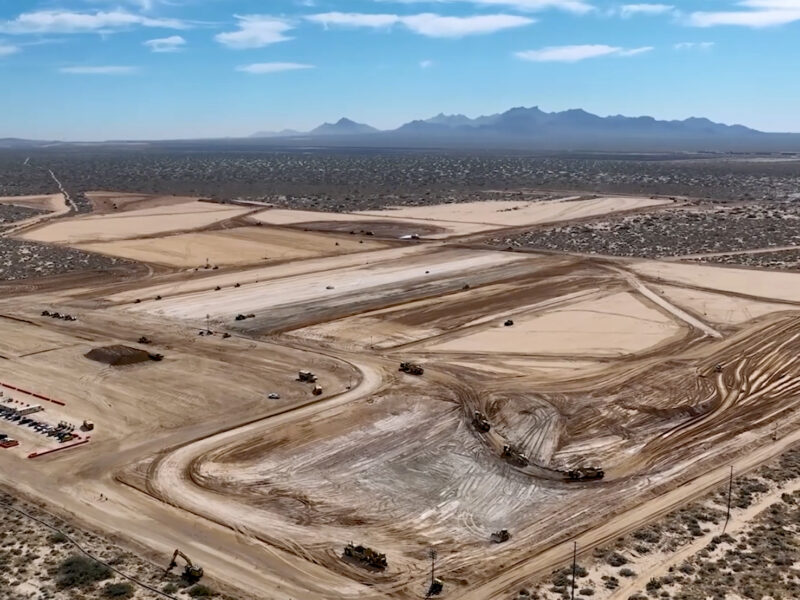
Staff from Doña Ana County and the state’s Economic Development Department have been negotiating in secret with the Project Jupiter developers on multiple agreements related to the company’s plans to build a campus of data centers and advanced manufacturing facilities in Santa Teresa. That’s the reason for the county’s NDAs.
The county released proposed agreements with the developers on Monday. County commissioners are scheduled to consider them at a Friday meeting.
One agreement would give the developers an exemption from paying property taxes for 30 years in exchange for commitments that include $360 million in annual PILOTS, or payments in lieu of taxes. The second agreement would provide gross receipts tax breaks in exchange for the creation of jobs and a $50 million grant to improve water and wastewater infrastructure in the southern portion of the county.
Commissioners saw the agreements for the first time along with the public on Monday. The five elected members of the county’s governing body are not covered by the NDAs and have been excluded from formal negotiations.
A push to delay the votes
Months of secret negotiations and only weeks for public consideration of the tax incentives has contributed to public skepticism and criticism. On Monday, the citizen group Las Cruces Indivisible released a statement calling for Friday’s votes to be tabled “until an oversight procedure can be established.”
“We feel there has been a lack of transparency to the public regarding Project Jupiter,” Indivisible said.
Last week, the League of Women Voters of Southern New Mexico called for delaying the votes “until the public has a meaningful opportunity to review and comment on the final draft ordinances and agreements.”
The City of Sunland Park joined the call on Tuesday to delay the votes. “We are not yet saying we are against the $165 billion bond or the data centers,” Mayor Javier Perea said in a news release. “What we are saying is that we need adequate time to study the massive project before making a determination.”
The proposed agreements the county released Monday are not yet finalized. Some are listed as “drafts.” Others include blank pages.
In addition, some of the commitments the company has publicly made are not included in documents that would make them legally binding.
I suggested last week that the county should hold a work session this week to unveil and discuss the legal agreements publicly with commissioners. No such meeting has been scheduled.
Commissioner Manuel Sanchez told me on Monday he’s hoping to hear from the public now that the proposed agreements are available for review. He didn’t say whether he believes the votes should proceed on Friday.
The companies have suggested they are considering other sites for the data center campus in case the county doesn’t approve the tax incentives. Because of that, county staff doesn’t want to delay the votes.
“We understand and appreciate the request for delay,” County Attorney Cari Neill told me Tuesday. “If we delay the vote, we will lose the option to be a part of this project. In essence, a delay is the same as voting ‘no’ because the companies will go elsewhere.”
State agency slow to release documents
I’m working to shine as much light on this project as I can before Friday’s meeting. The state’s Economic Development Department, to put it mildly, has been resistant to my efforts.
Because that state agency has been involved in negotiations, I requested a number of documents from it on Aug. 26, including any NDAs and economic impact analysis. After telling me it would respond by Sept. 12, it failed to do so. So I sent a reminder.
Then on Monday, EDD’s records custodian told me the agency had no documents other than one of the tax-incentive agreements the county released on Monday. Keep in mind the agency is legally required to provide any documents it has that are responsive to my request.
No NDAs? No economic analysis of the project? Nothing else after months of negotiations? Really? I responded in writing that I wanted explicit statements confirming those documents don’t exist.
On Tuesday, EDD sent me an economic impact analysis report. In response to my request for any confidentiality agreements, the agency wrote, “An NDA will be placed on the Economic Development Department’s website when one is available.”
When? And why not send it directly to me in response to my request?
I am still awaiting answers.
County has been more responsive
The response from the county has been far different. Neill provided me copies of the NDAs on Monday without any redactions. She took time to meet in person and answer my questions. Assistant County Manager Stephen Lopez has also taken time to answer my questions about the legal agreements and other topics.
I asked Neill about the differences between the paragraphs in the NMSU and county confidentiality agreements related to public records requests. She told me she proposed changes to the language Project Jupiter’s developers originally sought to ensure public protections before County Manager Scott Andrews signed the agreements.
“The county was insistent that we must comply with IPRA,” Neill said.
Stack and BorderPlex Digital have respected that need, she said. When the county receives a request for information related to Project Jupiter that could legally be kept confidential, the county has been asking the companies what it can release. The companies have been responding within 24-48 hours in most cases.
In some instances the companies have allowed the release of information that could legally be withheld, Neill said. Last week, the county released a less-redacted version of the companies’ application for bond financing that provided new details about job numbers and economic impact. She said the companies decided to release that information.
“They are working very hard to comply with our duty to provide the information to the public,” Neill said.
County commissioners excluded from negotiations
The county NDAs confirm that negotiations have been ongoing for months. The NDA with BorderPlex Digital took effect on May 28. The signatures on the agreement with Stack are dated July 30 and 31. Both agreements are signed by Andrews.
Meanwhile, several commissioners have said they weren’t given any specifics about Project Jupiter until mid-August.
While Commissioner Gloria Gameros told me last week that the NDAs bound commissioners, Neill said Monday that isn’t the case. Andrews only has authority to bind himself and county staff, she said.
“Confidential information is not being shared with the commissioners,” Neill said. “We made it very clear from the get-go that any information that was shared with the commissioners, it was assumed that information was going to become public record.”
Lopez has told me the decision to exclude commissioners from the negotiating process was made to preserve the line between operations and policymaking.
In addition, a quorum of commissioners being involved in closed-door negations — at least three of five — would violate the N.M. Open Meetings Act.
Sanchez said Monday he might have liked to participate in negotiations, citing the perspective commissioners would bring as the folks responsible for approving or rejecting the agreements.
“Part of me does wish that the commissioners were in on it,” he said.
Commissioners could have voted publicly to appoint two of their members to join negotiations on their behalf. In the past, I’ve seen commissioners join similar negotiations. That hasn’t happened in this case.
Commissioner Susana Chaparro expressed concern to me last week about the NDAs, saying staff should have alerted commissioners before Andrews signed them. She said she wasn’t told about the NDAs until she asked.
DISCLOSURE: My spouse, state Rep. Sarah Silva, participated in negotiations related to Project Jupiter and co-authored a column about the project that was published today. To preserve my ability to report on Project Jupiter and my spouse’s ability to do her job, I will not use anonymous sources in my articles about this topic. I will continue to report using documents and named sources only.


“Commissioners saw the agreements for the first time along with the public on Monday. The five elected members of the county’s governing body are not covered by the NDAs and have been excluded from formal negotiations.” It seems clear that the County Manager had no authority to bind the County, and everyone involved in the secret process should have known that. If it’s necessary to pre-negotiate in secret, that needs to be authorized in the statutes, and decision makers have to have time to review documents and get advice. Unfortunately, I have to question the County Attorney’s competence on this project.
Thanks for that feedback.
Great article. Thank you for helping us, concerned citizens of DAC, release critical information and transparency we deserve.
You’re welcome! And thank you!
“The companies have suggested they are considering other sites for the data center campus in case the county doesn’t approve the tax incentives. Because of that, county staff doesn’t want to delay the votes.
“We understand and appreciate the request for delay,” County Attorney Cari Neill told me Tuesday. “If we delay the vote, we will lose the option to be a part of this project. In essence, a delay is the same as voting ‘no’ because the companies will go elsewhere.”
Herein lies the crux of the matter; we now know precisely who holds the carrot and who holds the stick. The developers have secretly negotiated a quasi-ransom offer: “Play ball with us or we take the ball elsewhere and you lose the opportunity to capitalize on $165 BILLION DOLLARS.”
The proverbial gun to our heads is a ‘winner take all’ proposition; take us at our word, ignore the energy and water concerns or else this moment will disappear…
Those of us who have served as a public planning commissioner, committed to fair/transparent/due process deliberated in public, can see this debacle for what it is; pure exploitation and corruption of the public process with back-room deals being negotiated contrary to state laws – ironic given that Governor Lujan Grisham is leading the charge to circumvent the legal process to protect the state from the conduct she has engaged in.
I’m not trying to be cynical here, but the facts speak for themselves.
I appreciate your perspective. Thanks for sharing.
Powerful people at the State level negotiated it in secret and don’t want the risks of public debate so kept the local decision-makers and public in the dark and are pressuring the Commission and the public? So they’ve also invested in other secret campaigns and are ready to pressure them instead? Not ONE elected State official has an issue with the county manager signing an NDA to keep secret from his BOSSES? No statutory authority or vote? That undermines democratic government, regardless of the merits of the Project.
Amen! The four local governments that are part of the county have not received or been apprised of the “deal” that the county has been privy to for several months now. Based on that very important fact…POSTPONE THE IRB VOTE!
I do not oppose the concept of an AI data center in southern New Mexico; however, I have reservations about this particular data center proposal, these applicants, and the process involved.
If the public’s first chance to provide input is framed as “take it or leave it,” it may hinder productive engagement. Presenting the project with endorsements from most elected officials can reinforce public perceptions that political power remains in the hands of very few, and we, THE CITIZENS, HAVE TO “TAKE IT OR LEAVE IT”. This is a concern.
Commissioner Chaparro, Ms. Cadena as well as many concerned county residents have expressed concern regarding the Dona Ana County Manager’s signing of a confidentiality agreement and his authority to do so without informing local elected officials. This situation raises questions about compliance with the Open Meetings Act. The county attorney appears to support the applicant’s approach, which some view as limiting public input.
According to most recent thorough article by Heath Hausserman… The Commission was “given draft agreements totaling several hundred pages on Monday, 9/15/25, at the same time the public saw them. Those agreements were clearly not finalized. Some still have a “draft” watermark in the background. Others have blank pages.
“We understand and appreciate the request for delay,” County Attorney Cari Neill told me Tuesday. “If we delay the vote, we will lose the option to be a part of this project. In essence, a delay is the same as voting ‘no’ because the companies will go elsewhere.”
Not true. A Concerned Citizens did a deep dive into any applications submitted on behalf of “Borderplex Digital and/or Stacks” to the state of Wyoming and Minnesota unless they have organized under different LLC’s in those states. NO applications for any data centers have been submitted by Project Jupiter, Borderplex Digital or Stack Infrastructure or their affiliated LLCs listed on the NM SOS website in the supposed other locations.
The companies that are listed in the Borderplex Digital and Stack Infrastructure agreement with the NM State SOS are:
· (Yucca Growth Infrastructure (not registered on the NM SOS website), LLC, lead co.;
· Red Chiles A, LLC; Red Chiles B, LLC; Red Chile C, LLC; Red Chiles D, LLC; Green Chile Ventures LLC–all recently incorporated in Delaware. Filing date on the NM SOS website is 8/27/25)
Who is acting as the agent for the identified companies listed above? Yucca and Green Chile Ventures LLC(s) are Delaware registered LLCs but not listed on the NM SOS website.
Given these circumstances, we recommend a postponement of your vote for at least 60 days as well as a more open and transparent process which engages your constituencies when considering support for this project. Alternative proposals and processes may better serve the interests of the community and ensure broader input from all stakeholders.