 Heath Haussamen
THE DOCUMENTS:
• Proposed Project Jupiter agreements (starting on page 169)
PREVIOUS COVERAGE:
• NMSU releases Project Jupiter NDA, desalination agreement (Sept. 14)
• County releases Project Jupiter job, economic details (Sept. 12)
• Why are government agencies signing Project Jupiter NDAs? (Sept. 10)
• Project Jupiter agreements must protect water, residents (Sept. 8)
• Developer must guarantee Project Jupiter’s rosy promises (Sept. 3)
The developers of Project Jupiter commit to investing $50 million in water and wastewater infrastructure in southern Doña Ana County in a package of legally binding agreements commissioners will consider on Friday.
Many other public promises would be turned into legally binding agreements if commissioners approve the proposals. For example, the developers commit to job-creation numbers and deadlines and agree to penalties if they don’t meet those targets.
The details are included in proposed agreements the county released to the public Monday evening.
County staff are negotiating the deal, so commissioners were seeing the documents for the first time on Monday. Reached by phone, Commissioner Manuel Sanchez said he was pleased to see certain provisions, including money for continuing education programs.
Some are calling to delay Friday’s votes to give the public more time to review Project Jupiter. I asked Sanchez if he is prepared to vote later this week, now that he and the public can review the legal agreements.
Sanchez didn’t directly answer. He said he wants to hear from the public about the documents, which total several hundred pages.
“I know it’s a lot to get through,” Sanchez said, “but I’m hoping people will have a chance to look at it.”
He said the county has been trying to incorporate public feedback into negotiations.
“I heard people say they don’t want to be taken advantage of,” Sanchez said. “…We really are trying to ensure that we’re not being taken advantage of.”
The $50 million commitment
I have written previously that I want to see legal agreements protect our region’s water from data center consumption and require the developers to help build a clean water system to serve the residents of Santa Teresa and Sunland Park.
The documents the county released Monday get us halfway there. The commitment to invest $50 million in public water and wastewater infrastructure is required in an agreement to give the developers a 50 percent break on state and county gross receipts taxes.
In that proposed agreement, the developers commit to giving the first $50 million they receive in tax breaks back to the county “to be used exclusively for water and/or wastewater improvements in southern Doña Ana County.”
The county will have “sole discretion” on how to use those funds, the document states, “as long as the expenditure is related to water and/or wastewater.”
Payments instead of taxes
The developers’ $50 million pledge is in addition to regular payments they propose giving the county instead of property taxes.
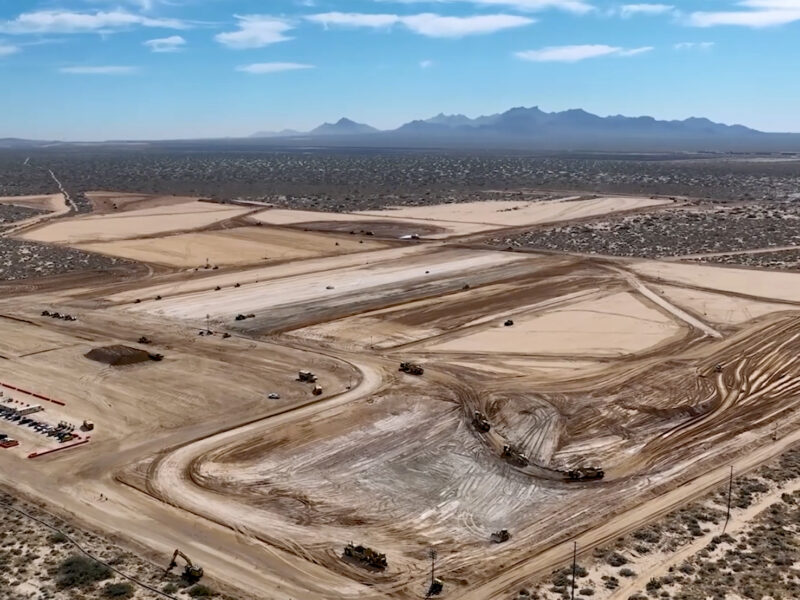
The 30-year property-tax exemption on the 1,400 acres where the campus of data centers and advanced manufacturing facilities would be built in Santa Teresa is the biggest incentive the county would provide developers.
A “non-binding” memorandum of understanding included in the documents released Monday says the payments made instead of property taxes would add up to $360 million over the 30 years.
But it’s difficult to verify that number in the legally binding documents. One page in a bond agreement that would detail those payments is blank. I’m not sure if it’s redacted or simply not filled out.
Water pledge, other grants
There are a couple of other sizable commitments included in the non-binding MOU that don’t appear in the legally binding documents.
The MOU restates the developers’ public pledge that its data centers will use a closed-loop cooling system for its electronic equipment, limiting the water it will consume. “The daily operational water use for the full data center campus buildout will be an average of 20,000 gallons per day with a maximum peak use capped at 60,000 gallons per day,” the MOU states.
That promise is not included in any legally binding documents.
Also included in the MOU are a series of “supplemental community investment funds” totaling $6.9 million. These are grants the developers pledge to provide to various projects.
They include $4 million for continuing education funds and a public safety facility, $1.5 million for construction of the new Boys and Girls Club facility in Las Cruces, $250,000 to help the county pay for its recent work to gather proposals from companies to build a desalination plant in the Santa Teresa area, $150,000 to improve regional transit, and $1 million for habitat restoration projects.
None of the legally binding agreements mentions those funds.
Some commitments would come later
Assistant County Manager Stephen Lopez said some legal commitments won’t come until later. The pledge to build a closed-loop water system “might end up being in the design plans when they go for construction permits,” he said. Even though the MOU isn’t binding, its existence will communicate the intent to staffers who review the permits.
Also, staffers at the water utility will know the intent from the MOU and “can simply hold them to the low water usage through allocation of water to the site,” he said.
As for the “supplemental community investment funds,” Lopez said he’s “not sure exactly where that one will end up on the enforceable side.” He said he will inquire about it.
Friday’s commission meeting, where favorable votes from a majority of commissioners would formalize the proposed agreements, begins at 9 a.m. It’s being held in the commission chambers at the Doña Ana County Government Center, 845 North Motel Boulevard in Las Cruces, and will be webcast live on the county’s YouTube channel.
DISCLOSURE: My spouse, state Rep. Sarah Silva, participated in negotiations on the $50 million water and wastewater commitment and the community investment funds detailed in this article. To preserve my ability to report on Project Jupiter and my spouse’s ability to do her job, I will not use anonymous sources in my articles about this topic. I will continue to report using documents and named sources only.


“Even though the MOU isn’t binding, its existence will communicate the intent to staffers who review the permits.” Not legally binding would mean there is no legal authority to deny approval based on the MOU, so what’s the point? THANK YOU for your reporting.
You’re welcome!
The article doesn’t include how $50 million for critical water/wastewater capital asset funding was decided upon by the applicant; i.e. how do we know that is enough, less than enough, more than enough money to address and resolve the water concern for the watershed.
Remind us again about the engineering partnership between NMSU civil engineering and Project Jupiter; does that partnership address the issue?
The truth is, the proposed Project Jupiter data center may require $1 Billion in capital asset critical infrastructure improvements to build a ‘state-of-the-art’ desalination water treatment plant to meet the water needs of the project and the region. If so, when will we know? After the $50 million has been spent and then the County will have to find $950 million more dollars – more municipal bond leverage – to resolve the problem they created.
The developers are running the show here, not the elected representatives who should be looking out for the interests of the constituents who elected them.
I have written a couple of times about NMSU’s work on a desalination plant for the region. Here’s one: https://haussamen.com/2025/09/03/developer-must-guarantee-project-jupiters-rosy-promises/
From that article:
Commissioner Gameros distributed a list of “answered” constituent questions. This document does much to answer questions about the project. I take issue with only one section: She (or staff) writes:
11. Will it negatively impact the air and environment quality?
a. No. Project Jupiter has been deliberately designed to protect both air quality and the broader environment.
This is physically impossible. Whether the power plant is 700 MW or 900 MW, it would be the largest natural gas power plant in the state! I posed the following prompt to ChatGPT, Claude, and DeepSeek: ” With the best, most efficient new gas turbines, what will the emissions of a 900 MW gas turbine complex be in equivalent passenger cars?”
ChatGPT: 489,000 – 514,000 passenger cars if running at 85% capacity
Claude: 467,000 passenger cars if running at 85% capacity
DeepSeek: 405,000 passenger cars if running at 60% capacity
You can quibble with which large language model is best, but these all consistently show enormous new emissions and smog for the entire region, affecting the health and welfare of over a million people … and of course, all of this worsens global warming as well!
Thank you for sharing!