 Heath Haussamen
THE DOCUMENTS:
• Contract related to development of desalination plant
• Non-disclosure agreement
PREVIOUS COVERAGE:
• County releases Project Jupiter job, economic details (Sept. 12)
• Why are government agencies signing Project Jupiter NDAs? (Sept. 10)
• Project Jupiter agreements must protect water, residents (Sept. 8)
• Developer must guarantee Project Jupiter’s rosy promises (Sept. 3)
New Mexico State University has a $30,000 contract to provide “advisory work and counseling” to a company involved in Project Jupiter related to the development of a water desalination plant.
As part of that work, the university and BorderPlex Digital Assets signed a non-disclosure agreement that allows documents to be labeled as proprietary.
The NDA requires NMSU to tell the company if any law or official order requires release of such documents before divulging them. And if the company decides to oppose release of those records, NMSU must “provide reasonable aid and assistance” in those efforts.
That appears to be a legally binding commitment by the university to err on the side of secrecy if BorderPlex Digital asks for it. That’s a concern many have expressed about such confidentiality agreements, which the developers of data centers are increasingly requiring from local government agencies across the nation.
The N.M. Foundation for Open Government has questioned the need for NDAs when state law already dictates what information government can withhold from the public — like company trade secrets — and what it must release.
The revelations about NMSU’s arrangement with BorderPlex Digital come from documents the university released Friday in response to a records request I submitted on Aug. 26. The university had pledged to respond by Friday, and did so at 4:58 p.m.
Because I received the documents at the end of the university’s work week, I haven’t yet been able speak with officials about them. I emailed questions on Sunday.
But I wanted to share the news with you as soon as possible, given the Doña Ana County Board of Commissioners’ rapidly approaching votes on Sept. 19 to provide tax incentives for the project.
The first NDA released publicly
NMSU joins the county and the Camino Real Regional Utility Authority (CRRUA), in entering into non-disclosure agreements with Project Jupiter’s developers. The university is the first to release an NDA in response to my records requests.
The county’s attorney told me last week that her office was still considering whether to release its NDAs. Then she told me Friday she will provide me with those documents on Monday.
CRRUA’s staff disclosed the existence of that agency’s NDA at a public meeting of its governing board last week. The utility was required to respond to my request for a copy of that NDA by Thursday, but has not yet done so.
I have requests out to state agencies involved in Project Jupiter as well. The Governor’s Office responded Friday to my request for any NDAs and other documents by deeming my request “excessively burdensome or broad” and requiring more time. That office promised another response by Sept. 29 — well after the county commission’s votes.
The state Economic Development Department also owed a response to my request for any NDAs and other documents by Friday. It failed to respond, even though I emailed the records custodian a reminder about the deadline.
NMSU’s confidentiality agreement is the earliest government document I have obtained related to Project Jupiter. Officials from NMSU and BorderPlex Digital signed it on Feb. 10.
A little more than two weeks later, on Feb. 25, the company and university entered into the contract related to the desalination plant. That same day, Gov. Michelle Lujan Grisham and BorderPlex Digital’s chairman, Lanham Napier, signed a memorandum of understanding and announced the project publicly.
It’s worth noting that the university’s NDA refers to the data center proposal as Project Nucleus, so the developers apparently changed the name later.
NMSU’s desalination work
The contact between NMSU and BorderPlex Digital relates to efforts led by Pei Xu, a civil engineering professor at the university who has been working for years on a water desalination feasibility study for the Santa Teresa area, where Project Jupiter would be built.
Fresh water is being depleted by use in the City of Sunland Park and the unincorporated Santa Teresa area, so being able to tap into the massive brackish groundwater aquifer underneath has become increasingly important.
The university’s work has included developing engineering designs for a desalination plant. The researchers estimated the cost in 2023 to be between $35 million and $192 million depending on the capacity needed, with a mid-range system estimated to have a total construction cost of almost $133 million.
The documents NMSU released Friday don’t explain BorderPlex Digital’s involvement in the desalination efforts. Was the company looking to build its own plant? Providing funding to support and speed along existing government efforts? Buying goodwill as it sought changes in state law and regulatory paths toward approval of its data center project?
Though many data centers use lots of water, the Project Jupiter developers have pledged, at least verbally, to use a “closed loop, non-evaporative cooling technology.” They say it will require a one-time fill-up and no additional water after that.
They promise only regular ongoing water use for several hundred employees after that — though their planned microgrid, which will include natural gas power generation, will also use water.
NMSU’s contract with BorderPlex Digital has the university participating in an investigation of the brackish aquifer along with the state engineer.
The contract also requires NMSU to provide feedback to EPCOR — which I am guessing, but have not verified, is the North American water and power company that has a New Mexico office — as EPCOR investigates water-rights permitting and other logistics, including locations for a facility, development plans and cost estimates.
This is the first time I’ve seen EPCOR mentioned in documents related to Project Jupiter.
Project Jupiter’s public pledge
In recent weeks, Project Jupiter has pledged on its website to “invest tens of millions of dollars in essential county water infrastructure improvements” beyond what it needs for its own facilities. Such an investment recognizes “the critical importance of safe and reliable drinking water” and is intended “to strengthen long-term water security and sustainability for the entire region,” the website states.
I’m still waiting for the county to release the agreements with the developers of Project Jupiter that commissioners will consider at their Sept. 19 meeting. Among my questions is whether that water pledge will be quantified and required in a written agreement.
DISCLOSURE: My spouse, state Rep. Sarah Silva, participated in negotiations related to Project Jupiter. To preserve my ability to report on Project Jupiter and my spouse’s ability to do her job, I will not use anonymous sources in my articles about this topic. I will continue to report using documents and named sources only.
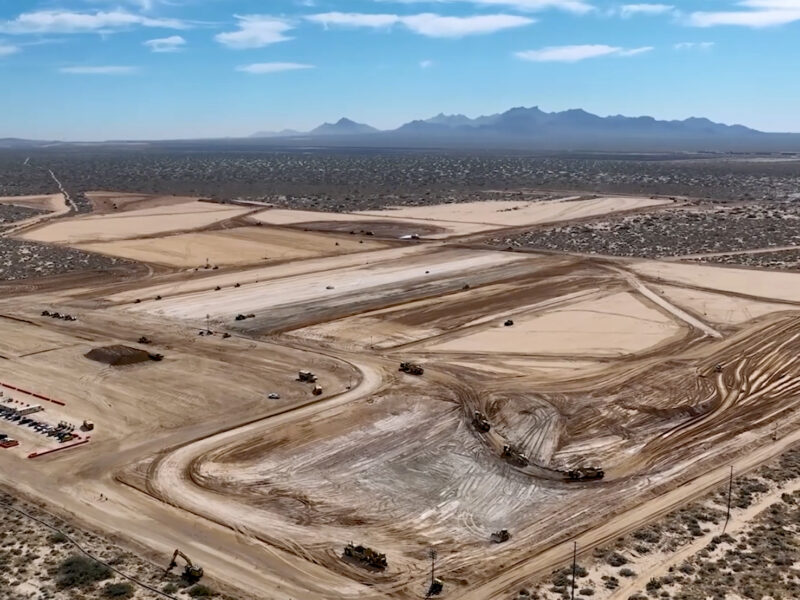


“They say it will require a one-time fill-up and no additional water after that.”
Based on my experiences with closed loop cooling systems in power plant applications, the basic technology is sound. But there has to be a heat sink for that closed loop to do its job. What kind of heat sink will be used?
The statement made about ‘one-time fill-up’ is not accurate. What about make-up for system leakage (valves and pumps can be made nearly but not 100% leak free)? What about refilling the system following maintenance? What about water lost from the heat sink, presuming some sort of evaporative heat sink that collects and rejects the closed loop heat?
Thank you for articulating those technical questions!
Thank you for this reporting. My comment has two parts: 1) the legal constraints on new water development in the Lower Rio Grande, and 2) a request for NMSU, my alma mater, to uphold transparency and scientific integrity. I am a retired, licensed water engineer and know of what I write below.
Legal context. The Lower Rio Grande has been under active litigation since 2013 before the U.S. Supreme Court due to its unregulated overuse of water. On Aug. 29, 2025, the State Engineer filed settlement documents requiring New Mexico to reduce depletions by fallowing 9,240 acres of active farms to stop 18,200 acre-feet of depletions annually. New Mexico is required to submit a detailed compliance plan in two years.
New depletions at this moment, no matter how they are packaged, risk violating Compact obligations and undermining the settlement. Claims that CRRUA can “guarantee” new supply are unrealistic given both the settlement’s strict requirements and CRRUA’s long record of violating water quality requirements and its objectivity, honesty, transparency, and governance problems that have been widely reported.
Transparency and integrity. NMSU’s nondisclosure agreement with BorderPlex Digital creates a presumption of secrecy when state law already defines what may be withheld and what must be released. That undermines public confidence. The NDA contradicts the spirit of open government and raises questions about whether the university is aligning with public interest or with a private developer.
Civil Engineering Professor Pei Xu and other NMSU researchers have the expertise to explain the unresolved technical barriers: where brackish groundwater could be pumped without Compact injury, and how to manage the large volumes of waste concentrate. Until those answers are made public and independently verified, talk of “closed-loop” systems and minimal water use remains a salesman’s claim based on half-truths, not the whole, objective, honest truth.
Project Jupiter proponents and local governments should not press forward with incentives until the legal, hydrologic, and waste-disposal questions are addressed openly. The public deserves professionalism, honesty, objectivity, and transparency from its universities and enforceable protections by state and local governments before they give away more farms.
Thank you for your comments. I really appreciate you weighing in with your opinion and expertise. I have heard some of these points before, and honestly, given what time there is before the county commission’s votes, I’ve just been moving quickly to get as much information to the public as I can before the vote and haven’t had the time to get into that issue, at least yet.
Thank you for all your informative efforts re: Project Jupiter
You’re welcome!
Good morning and thanks again for the in-depth reporting. Just before all of this hit the biggest news in the County was the dissolution of CRRUA. It concerns me that the split of CRRUA between County and Sunland Park would not allow proper oversight of the infrastructure proposed for this project. In one public meeting the Project indicated that the desalination wastestream would be pretreated somehow then discharged to the wastewater plant. Desal also loses about 30% of the water treated. Finally you are correct in assuming that most contractors would come from El Paso. If we look at the Spaceport project we see exactly the same promises: education benefits, local contractors, no Dona Ana County benefit, a handful of local jobs, and a bond that is still not paid.
Hi! Thank you for weighing in on this! I really appreciate your input.
I appreciate your thoughts also. Given your former service on the Commission, do you have an opinion on NDA’s signed without a public hearing and vote?