 Heath Haussamen
CATCH UP on my previous coverage of Project Jupiter:
Why are government agencies signing Project Jupiter NDAs? (Sept. 10)
Project Jupiter agreements must protect water, residents (Sept. 8)
Developer must guarantee Project Jupiter’s rosy promises (Sept. 3)
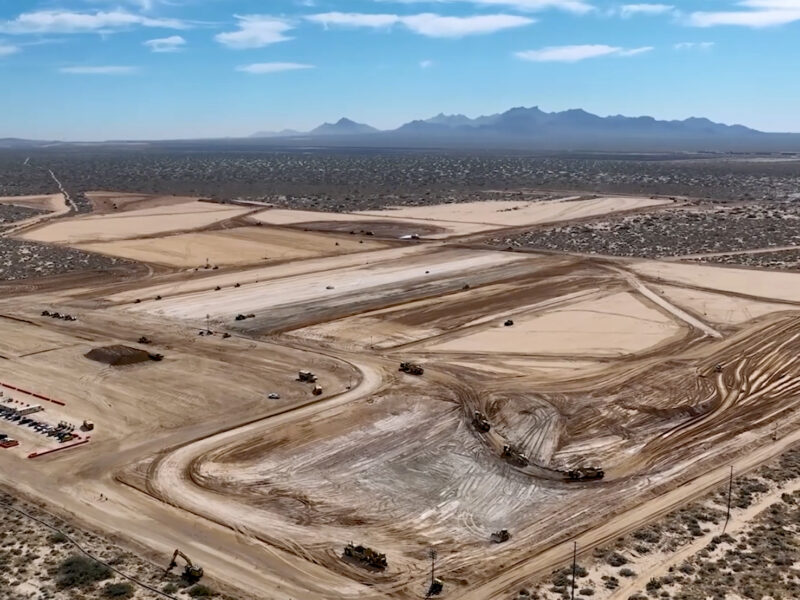
Doña Ana County released a less-redacted version of the Project Jupiter developers’ application for $165 billion in bond financing on Friday. The newly public portions reveal more details about the scale of the planned campus of data centers and pledge a substantial impact on the local economy.
The application asks developers to provide information about revenue and expenses — the numbers that help determine impact on the local economy.
The Project Jupiter developers divided their numbers into two categories. One is for the construction of the microgrid that will power the data centers. The second is for the data centers themselves.
The microgrid numbers alone are substantial.
The developers hope to begin construction in the last three months of this year and complete the microgrid and data centers nearly three years later, in the third quarter of 2028. By that third year, the developers estimate in their application that the microgrid will generate a little more than $1.28 billion annually in sales for the company over the remainder of the 30-year bonds.
On the expense side, they estimate spending $125 million annually with local contractors by year three — though how many of those contractors will be from New Mexico, as opposed to El Paso, Texas or even Ciudad Juárez, Mexico isn’t stated.
And they estimate an employee payroll for the microgrid of $11 million annually. That’s based on an estimate of 100 jobs for people who will operate the microgrid. Those jobs will pay an average salary of $125,000 per year, the application states.
As for the data centers themselves, the developers’ application doesn’t include numbers for overall sales and spending with local contractors. It states “TBD” where those numbers would be.
But it does contain job numbers.
By the third year of operation, the application estimates Project Jupiter will create 700 permanent jobs in tech and management fields, with an average annual salary of $75,000-$110,000. Overall spending on employees for the data centers by year three would be an estimated $69.3 million, according to the application. That annual amount would continue through the remainder of the 30-year bonds.
The campus of data centers would be built on 1,400 acres in Santa Teresa, the newly released information states. As we already knew, it would be constructed on the southeast corner of N.M. Highway 136 and N.M. Highway 9, just north of the Santa Teresa Industrial Park.
The multiplying effect
The creation of new jobs has a multiplying economic impact across a community. In this instance, new spending includes Stack Infrastructure, the builder of Project Jupiter, hiring its own employees and contracting with other businesses to provide services. Employees of Stack and those other businesses then spend money they earn from those jobs at restaurants, to pay for child care, and so on.
The Economic Policy Institute estimates those multipliers by industry, because some categories of jobs have a greater economic impact than others. In construction — which is obviously a big part of this data center project — 100 direct jobs create an additional 226 indirect jobs, the Institute estimates.
In their application for bond financing, the developers of Project Jupiter estimate creating 2,500 construction jobs during the building phase (the first three years or so of the project), which by that estimate would indirectly create another 5,650 jobs.
Then there are the long-term job numbers. The microgrid portion of the project should fall under the utilities category as a multiplier. So by the Institute’s estimate, once the microgrid is operational those 100 permanent jobs would lead to the creation of an additional 958 indirect jobs.
And based on the information classification, which is how the data center project should be categorized, the Institute estimates the indirect creation of 573 jobs for every 100 directly created. So the 700 permanent jobs the developers estimate in that category would lead to an additional 4,011 in indirect jobs.
Contracts are coming
The numbers paint an optimistic picture, but the Project Jupiter developers’ application is not a contractual commitment. The good news: Some of the job-creation numbers will become binding if county commissioners vote to proceed with the project on Sept. 19.
An agreement to provide tax breaks will tie those incentives to economic commitments. It will also include clawbacks and potential penalties if the developers fall short of their promises.
And the bond agreement will require that the construction jobs pay what’s called the “prevailing wage” — a number equal to what government would pay on a public project, which gives unions a shot at winning the construction contracts.
The agreements commissioners will consider on Sept. 19 should become public early next week. I’m planning to share those documents and write about them once I receive them.
I don’t know why the county provided the new information from the developers’ application to me on Friday, after previously promising it would do so only after the Sept. 19 meeting. And there are still a few redacted details I’d eventually like to see.
County Attorney Cari Neill said she would answer my questions at a meeting we have scheduled for Monday. I will keep you updated.
DISCLOSURE: My spouse, state Rep. Sarah Silva, participated in negotiations related to Project Jupiter. To preserve my ability to report on Project Jupiter and my spouse’s ability to do her job, I will not use anonymous sources in my articles about this topic. I will continue to report using documents and named sources only.


I am guessing that the “average” annual salary number given is the mean. But one or two really high salaries could be skewing that number a lot. A y idea what the median salary is predicted to be? “the application estimates Project Jupiter will create 700 permanent jobs in tech and management fields, with an average annual salary of $75,000-$110,000.”
Hi! I can’t tell you more than the application says so I’m attaching the relevant page to this comment.
Thank you for this thorough reporting.
You’re welcome!
I would certainly like to be FOR this project, but their emphasis on natural gas is troubling. To power even the early stages will require a 350 – 400 MW natural gas plant, which will create the emissions of approximately 300,000 passenger cars! This will add enormously to our air pollution and smog in an area already in ozone non-attainment.
I was very puzzled when Commissioner Reynolds assured me the facility will be totally off-grid, since this is unusual for a micro-grid system. Upon doing further research, I discovered if their micro-grid does not interconnect with EPE, and the electricity is solely for the use of the data centers, they do not fall under the jurisdiction of the NMPRC.
Although the PRC’s central role is ratepayer protection, a PRC review provides more than that. It includes evaluating the need for new generation, whether cleaner or more cost-effective alternatives exist, and how the plant fits into long-term resource planning for the region. If Project Jupiter’s plant avoids PRC oversight, the community loses those broader protections, and decisions about scale, fuel choice, and alternatives rest almost entirely with the developer.
The last-minute amendments to HB93 that allowed microgrids are certainly interesting.